IOA Stay

Prague Guide · History

Jan Hus and Prague: The City Where the Revolution Began

Hus transformed Prague from a university town into the centre of the European reformation. Thirty chapters, a timeline, then-and-now comparisons and a walking route through seven places connected with Jan Hus.

IOA STAY EDITORIAL TEAM·October 14, 2026·40 MIN READ

Part I

Prague Before Jan Hus

01Prague after Charles IV: a city at the height of its glory

When Jan Hus arrived at the University of Prague around 1390, he entered a city that had recently lived through its most magnificent period. Within a single generation, Charles IV had turned it into the political and cultural centre of the Holy Roman Empire. In 1344 Prague received its own archbishopric and ceased to be subject to the metropolitan see of Mainz. The first Archbishop of Prague was Arnošt of Pardubice, one of Charles’s closest collaborators.

In 1348 Charles issued two documents that shaped the city for centuries to come: on 7 April he founded the University of Prague, modelled on Paris and Bologna — the first university in Central Europe — and on 8 March he founded the New Town of Prague, one of the largest urban planning projects of medieval Europe. Add Charles Bridge from 1357 and the extensive rebuilding of Prague Castle, and the result was a metropolis that ranked among the largest in Central Europe. Charles-era buildings still form the backbone of Prague’s heritage reserve today, and most of them survive in a form Hus himself could have remembered.

The foundation of the city’s prosperity was the Kutná Hora silver district and the coinage established by Wenceslas II at the start of the 14th century. Prague was a centre of trade, crafts and church administration with a dense network of parishes, monasteries and hospitals. Society was strictly hierarchical: patricians sat on the town council, craftsmen organised themselves in guilds, and at the sources of wealth stood the great landowners — the church, the nobility and the king.

Charles IV died on 29 November 1378. The throne passed to his son Wenceslas IV, crowned already during his father’s lifetime, but a more temperamental and less balanced ruler. His reign struggled from the start with conflicts with the nobility, the towns and the church; in 1394 the nobility even detained Wenceslas, and in 1400 the German prince-electors voted to depose him from the Roman throne. Amid this ferment of medieval politics, Prague after 1400 entered an era in which royal power was weakened and every group — the city, the university, the archbishop, the nobility — defended its own interest. All of Hus’s Prague years belong to precisely this environment.
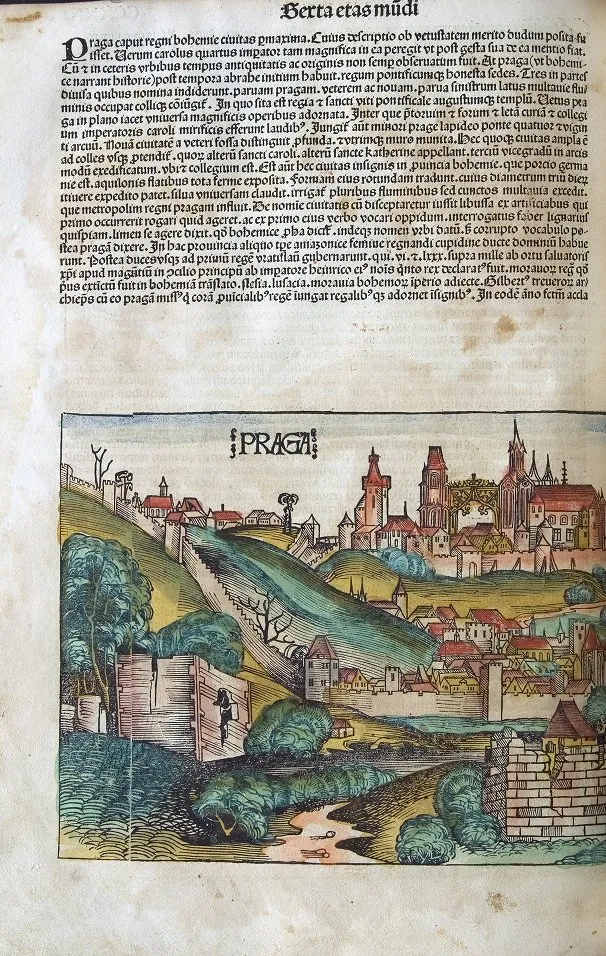
Woodcut of Prague from Schedel’s Weltchronik of 1493
Prague in a contemporary rendering from Hartmann Schedel’s Liber chronicarum (1493). The print was made more than a century after Hus’s time, yet it preserves the period image of a city of castles, bridges and towers. Hartmann Schedel, Wikimedia Commons, public domain

02What Prague around 1400 really looked like

Prague around 1400 was not one city but four neighbouring townships, each with its own council and rights: Hradčany and the Lesser Town on the left bank, the Old Town and the New Town on the right. Population estimates in the literature range roughly from thirty to forty thousand; we do not know the exact number and every author works with a different calculation. What is certain is that within Central Europe this was a metropolis of the first order.

The city was ringed by walls with gates; inside, the stone houses of patricians stood beside the timber-framed dwellings of the poor in the suburbs. Life revolved around marketplaces: on the Old Town Square everything was sold, from meat to cloth; the Horse Market — today’s Wenceslas Square — hosted the cattle and horse trade, while the Cattle Market on Charles Square served for the sale of livestock. Public fountains supplied water; there was no sewerage in the modern sense — refuse ran off through street gutters, and epidemics, plague above all, returned at intervals of about a decade.

Society consisted of three main estates. The clergy, with its many parishes, monasteries and chapels, was rich and highly visible; its conduct — from negligence to a scandalous way of life — became a target of the reforming preachers. The burghers lived from trade and crafts and competed in the state with the patrician clans and the nobility. And the third estate — the rural and urban poor — formed the majority of the population; on them the social tensions accumulated that later erupted in the Hussite revolution.

Prague was bilingual: alongside Czech, German was spoken, and Latin was used in academic and ecclesiastical circles. Wenceslas IV often resided at Prague Castle, and his court attracted artists and moneylenders alike. Into this environment — noisy, wealthy, full of groups competing with one another — came the young Jan Hus, and in it he found both a university and an audience for his sermons.

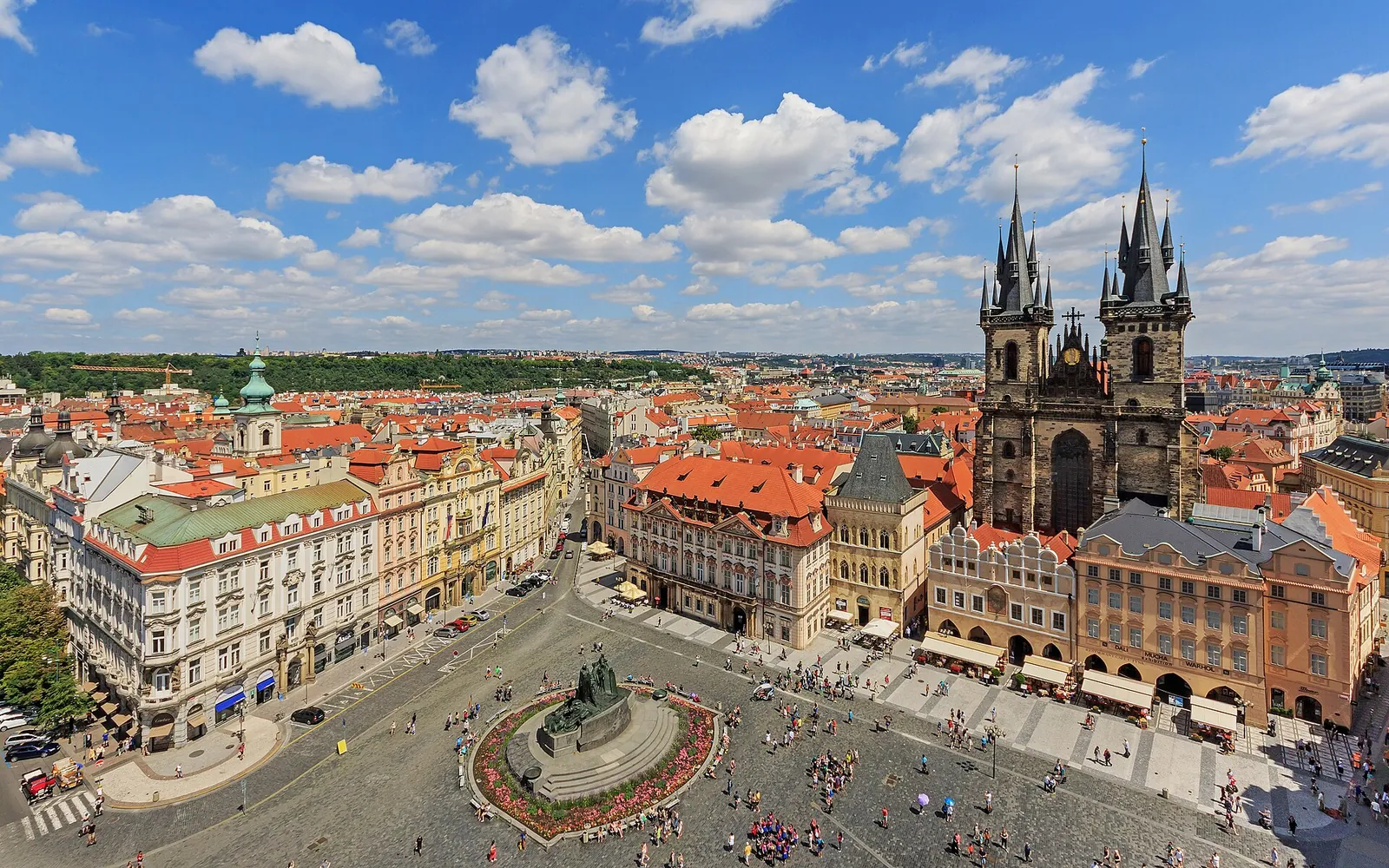
View of the Old Town Square from the tower of the Old Town Hall
The Old Town Square today, seen from the tower of the Old Town Hall. The shape of the square has changed little since Hus’s time; the Hus monument now stands in its northern part. Photo: A. Savin, Wikimedia Commons, FAL

03Prague as a European university city

The Prague studium generale, founded in 1348, was the first university in Central Europe. Charles IV established it on the model of Paris, then the academic centre of Europe, with respect for the legal traditions of Bologna. The university had four faculties: arts, law, medicine and theology, with theology remaining the summit of the academic pyramid. Students first devoted themselves to the liberal arts — grammar, rhetoric, dialectic, arithmetic, geometry, astronomy and music — and only after their bachelor’s and master’s examinations could they proceed to the higher faculties.

The university was made up not of individual students but of "nations" — associations based on place of origin. There were four nations in Prague: the Bohemian, the Bavarian, the Saxon and the Polish (Silesian). Each had one vote in the election of the rector; Bohemian students and masters were therefore a minority in the university’s decision-making, even though they were the most numerous group. This system, inherited from Paris, became the object of a fierce political struggle under Wenceslas IV and culminated in the Decree of Kutná Hora in 1409.

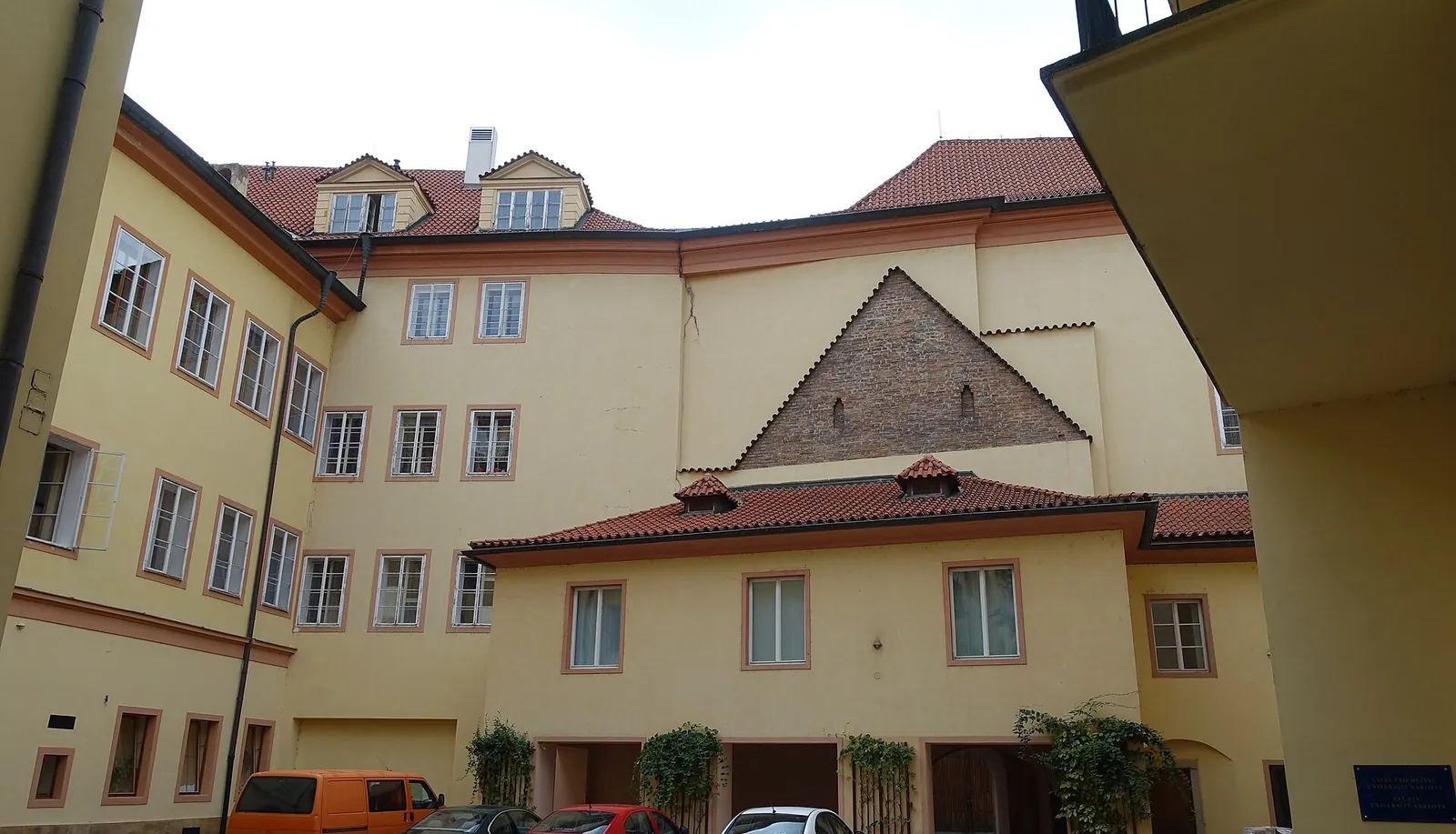
The university was housed in several colleges; an important position belonged to Charles’s College, founded by Charles IV in 1366 and later expanded with buildings near the Fruit Market, from which today’s Karolinum developed. Academic life was public: disputations were held before lay audiences, burghers attended professors’ sermons, and the university had its own jurisdiction and seal. In this way Prague became a centre that shaped the elites of the whole of Central Europe — and at the same time an environment where, at the end of the 14th century, reforming ideas began to spread, ideas to which the university itself stood in an uneasy relationship.

The Karolinum courtyard, the historic precinct of Charles University
The Karolinum courtyard, the historic seat of Charles University. From the 14th century the university’s offices, colleges and the hall where disputations and ceremonial acts took place moved into the Karolinum. Photo: David Short, Wikimedia Commons, CC BY 2.0

Part II

The Young Jan Hus

04From Husinec to Prague

Jan Hus was born in Husinec in southern Bohemia, probably in the early 1370s. His exact date of birth has not survived and little is known about his childhood: the family was modest and, according to later reports, of craft background. What is certain is the origin of his surname — "Hus" refers to his native village; in Latinised form he signed himself Johannes Huss de Gusinetz.

He came to Prague as a boy or young man, probably in the early 1390s. He enrolled in the Faculty of Arts of the University of Prague, became a Bachelor of Liberal Arts in 1393 and a Master three years later. This was a fast pace, suggesting exceptional ability and great diligence. As a poor country student he had to finance his studies himself; later biographies have him singing in church and taking small jobs for his keep. It is the classic path of a country boy who worked his way up by his own effort. Today it is hard to separate later legends from facts; only the academic examinations and their dates are documented.

Hus’s path led on towards holy orders: he was ordained a priest in 1400. Scholarly literature offers conflicting conjectures about his theological background; what is certain is that the young master increasingly inclined towards the practical preaching and reform line, for which Prague offered a surprisingly open field. The Bohemian reform movement — today described as the pre-Hussite reformation — already had a decade of tradition in Prague and found its exponents precisely among the young university masters.

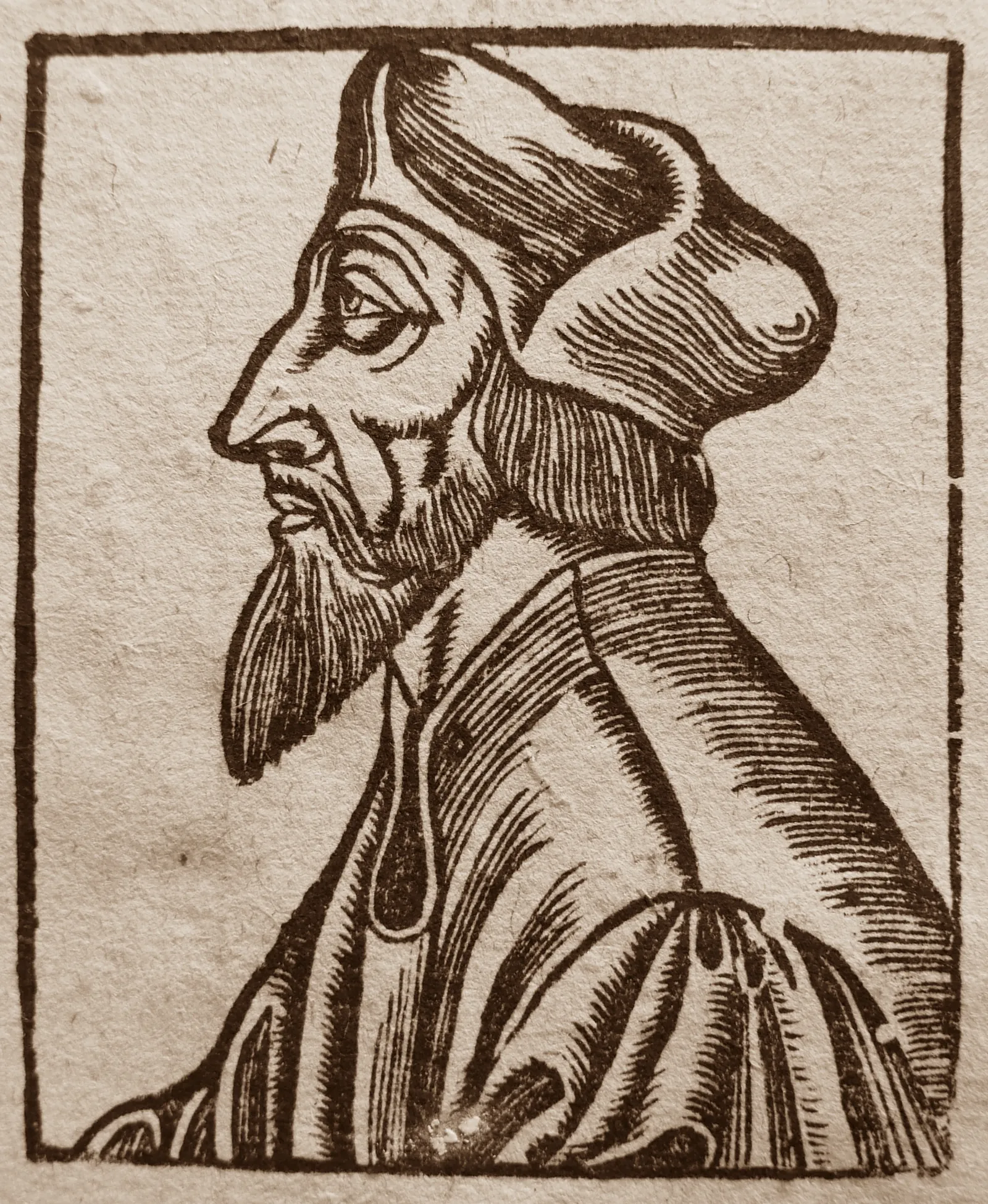
Woodcut of Jan Hus from Sebastian Münster’s Cosmographiae universalis
Jan Hus in a woodcut from Sebastian Münster’s Cosmographia universalis (16th century). This is a later artistic rendering, not a lifetime portrait; no likeness of Hus from his own lifetime has survived. Sebastian Münster, Wikimedia Commons, CC0

05Jan Hus as a university master

Hus taught at the Faculty of Arts, served as dean at the beginning of the 15th century, and in 1409–1410 held the highest university office — that of rector. Among the masters he was respected and repeatedly elected to academic offices, and his lectures drew students. Yet alongside his teaching in the arts he remained closely tied to preaching practice, which was less usual for a university master.

A decisive influence on his thinking was John Wycliffe, the English theologian and critic of the church’s wealth. Wycliffe’s writings had circulated in Prague since the end of the 14th century, and Hus, like a number of other Bohemian masters, adopted from them the idea that the church has no divinely guaranteed right to hold temporal property, and that the true head of the church is Christ, not the pope. Wycliffe’s influence gave the young Prague reformation an intellectual breakthrough: theoretical criticism acquired a philosophical framework that could be defended in disputations.

The university environment thereby split. Some — among them the young Bohemian masters around Hus — saw in Wycliffe an important thinker of reform; others, mainly the German masters and part of the theologians, saw in his teaching the threat of heresy. These academic disputes — disputations, sermons, literary exchanges — formed the background from which Hus’s later conflicts with the church hierarchy grew. It was a battle over words at a university that within less than two decades turned into a battle over the future of an entire kingdom.

06Hus’s first sermons in Prague

Hus’s historically documented early preaching was based in two places in the Old Town. He first preached, around 1402, in the Dominican monastic church of St Michael in Michael Street (Michalská), near the present-day church of St Giles. It was a typical first pulpit for a young priest, and at the same time it gave him contact with an urban audience. Around the same year he moved — or was called — to the Bethlehem Chapel, where he developed the preaching that marked Prague for generations.

The church of St Michael has not survived in its original form as a monument: under the Josephine reforms it was dissolved and profaned in 1786, and its fabric became part of the Dominican monastic block known today as the monastery of St Giles in Michael Street. The site can be found in the street block between Michalská and Jilská. What the visitor sees today is not a medieval interior but authentic streets and the perimeter walls of the monastic precinct in which Hus’s preaching once sounded.

This shift from a monastic church to the public Bethlehem Chapel has a double significance: it marked Hus’s entry into a wider public, and at the same time showed that both the ecclesiastical and the urban elite had an interest in reforming preaching. The chapel had been founded as a private endowment for preaching in Czech — and precisely there, where the urban community met the reform movement, Hus found his true home.

Part III

The Bethlehem Chapel

07The Bethlehem Chapel: the place where Prague listened to Hus

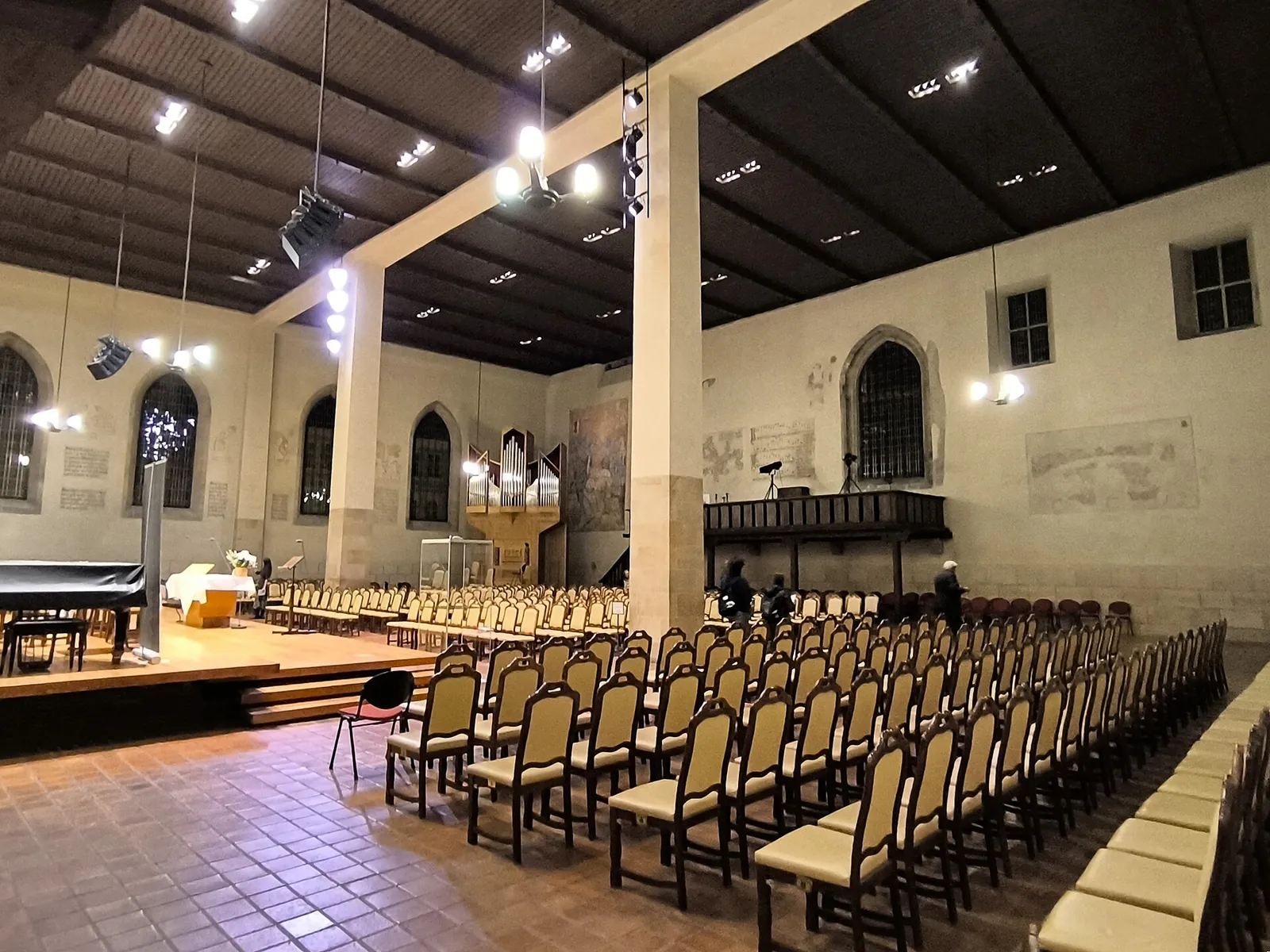
The Bethlehem Chapel was founded on 24 May 1391 by the Prague burghers Jan Kříž and Hanuš of Mühlheim. Their motivation was clear and, for its time, modern: to create a space for preaching in Czech, comprehensible to the urban population, which did not know Latin. The building was probably completed in 1394. The chapel thus became part of a wider movement for the reform of preaching that in the 14th century crossed the borders of Bohemia — similar preaching institutions were founded elsewhere in Europe too.

The chapel’s architecture was functional: a spacious brick hall without a church tower, with galleries along the walls that greatly enlarged the area for listeners. Reports of its capacity differ in the literature; several thousand people are often mentioned, though this is rather an estimate based on later sources than a documented figure. What is certain is that a substantial part of Prague’s urban community could fit into the chapel, and that sermons here had the character of public events, not marginal devotional exercises.

In 1402 Hus became the preacher of the Bethlehem Chapel. Regular sermons in Czech shaped public opinion: criticism of the clergy’s morals, exposition of Scripture, commentary on the condition of the church. The listeners came from the urban community, the university and the royal court alike. The chapel thus became a kind of civic forum where academic discourse met the everyday experience of Praguers. It is precisely this connectedness that explains why Hus’s preaching soon had not only a religious but also a political impact.

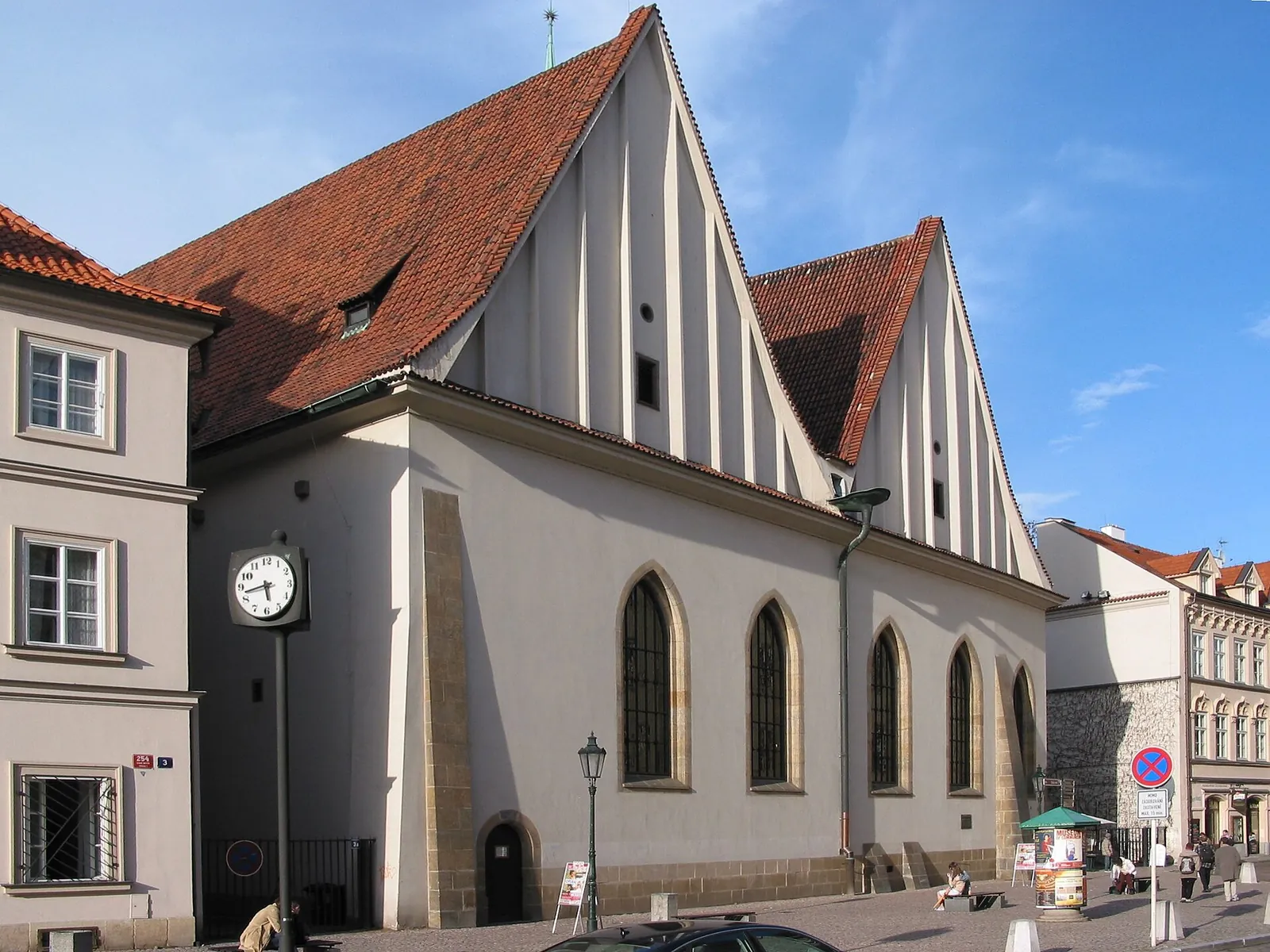
The Bethlehem Chapel has survived to the present day in a form strongly shaped by the modern era. In 1786 the Josephine reforms profaned it, and the building gradually served the most varied purposes; of the original structure only the fabric of the perimeter walls survives. The reconstruction of 1950–1954 restored the space according to period descriptions; the wall frescoes with song texts and biblical quotations are a work of the modern age and should be understood as a narrative of a form that cannot be fully documented. Today the chapel belongs to the Evangelical Church of Czech Brethren and is open to the public.

The Bethlehem Chapel in Prague from the outside
The Bethlehem Chapel from Bethlehem Street (Betlémská). The surviving fabric corresponds to the Gothic chapel of 1391–1394; the interior is the result of the 1950–1954 reconstruction. Photo: Kf, Wikimedia Commons, public domain

08What Jan Hus actually preached

Hus’s preaching stood on three pillars. The first was criticism of the moral condition of the church: he preached against priests who lived in luxury, demanded payment for the appointment to parishes, or led lives that contradicted what they proclaimed. This was not an attack on the church as an institution — Hus remained a priest and never renounced his loyalty to the church — but a demand that the clergy behave according to what they profess.

The second pillar was strengthening the authority of Scripture. Hus emphasised that Christ is the head of the church and that church statutes and practices cannot be placed above the Gospel. He rejected simony — the trafficking in spiritual goods and offices — and insisted that church practices must be measured against Scripture. In this he offered Praguers a conception of the church as a community of the predestined just, founded on God’s foreordination rather than on the earthly hierarchy of wealth and office.

The third pillar was freedom of conscience and personal responsibility. Hus urged people not to obey an order that would set them against God — the stance that ultimately proved fatal for him at Constance. In practice it meant that a listener had the right to refuse a priestly command that contradicted God’s law.

Hus’s position must be distinguished from Wycliffe’s. Wycliffe went further: he rejected the church’s ownership of temporal property altogether, and his theology tended towards anti-hierarchical positions. Hus retained the sacraments and the church office; his reformism was more moderate and closely bound to the Prague milieu. Yet from this difference arose a far broader social upheaval — precisely because Hus preached his theology regularly, and in Czech, to thousands, and not only in Latin disputations.

09Where Jan Hus lived in Prague

It is historically documented that as the preacher of the Bethlehem Chapel Hus was among the people resident at the chapel. The preacher’s house near the Bethlehem Chapel — today called the Kazatelna (Pulpit) — served as the dwelling of the preacher and his household. Unlike many legends, there is no need to invent exotic addresses: Hus lived in the immediate vicinity of the place of his preaching, in the urban setting of the Old or New Town, as befitted the position of a university master with a steady income from his office.

His daily routine can be reconstructed only in general terms, not from documented sources. A sermon or mass in the morning, teaching and disputations at the university during the day, preparation of sermons and writings in the evening. He drew on a network of friends and supporters: university masters, urban patricians, noblemen of the reform party. What is documented is his literary output — in Czech and in Latin — which could not have arisen without a stable working base and access to books.

Today the visitor will find in Bethlehem Street the restored space of the chapel and the adjoining Kazatelna building, where an exhibition commemorates Jan Hus and the history of the chapel. It must be emphasised: this quarter is the result of 20th-century reconstruction, not the authentic preservation of Hus’s home. Hus’s dwelling thus survives today more as an idea than as a heritage-documented building.

10Queen Žofie in the Bethlehem Chapel

Žofie of Bavaria, married to King Wenceslas IV in 1389, was one of the most prominent women of the Bohemian court. Her marriage was not happy and the royal court stumbled through debt and political crises, but Žofie kept an independent stance. It is historically documented that she attended Hus’s sermons in the Bethlehem Chapel and maintained contact with him; later chronicles also credit her with sincere grief at the news of Hus’s death. Such details, however, must be taken as storytelling, not as documented fact.

Žofie’s significance lies in what it reveals about the politics of the day: reforming preaching was not merely a matter of the university and the urban poor, but reached as far as the royal court. As a protectress of the reforming preachers, the queen gave Hus prestigious cover whose absence would have considerably complicated his position in Prague. Her stance also shows how, for influential people, the question of religious reform became a question of personal conscience rather than merely one of hierarchy and power.

Wenceslas IV himself took a rather pragmatic stance towards Hus: he protected him as long as the reform movement served him as a counterweight to the church and the nobility, but at decisive moments he was not willing to pay a personal price for Hus. The relationship between king, university and church was therefore a constant negotiation — and it was precisely this friction that created the space Hus and his friends used. When Wenceslas died in 1419, reformist Prague stood on the threshold of events that no ruler would ever stop.

Part IV

Prague Divides

11John Wycliffe and the ideas that came from England

John Wycliffe, the Oxford theologian who died in 1384, left behind a body of work that became the intellectual foundation of the whole European reformation before Luther. He criticised the wealth and temporal property of the church, questioned the papal primacy at a moment when the papacy was in deep crisis, and placed the authority of Scripture above church decrees. His teaching brought new questions to Prague: what is the church, who has the right to rule, where does truth lie.

Wycliffe’s writings reached Prague at the start of the 15th century, probably with the help of Jerome of Prague, who had studied in England and brought his ideas home. In the university milieu they caused a stir: some masters welcomed them as learned support for reform, others saw in them heresy. Hus, like other Bohemian masters, read Wycliffe, adopted parts of his teaching and formulated his own position — in agreement on questions of the church, reserved where Wycliffe wandered into areas Hus considered disputable.

The academic quarrels must be distinguished from the theological ones. The university competed for influence and voting rights; the theologians argued over the correct interpretations of the faith; Wycliffe’s question lay at the intersection. In Prague, therefore, two currents were set in motion: the intra-academic struggle for influence and the struggle over the true confession. The second eventually decided the fate of Jan Hus — and after him, of the whole kingdom.

12The Decree of Kutná Hora, 1409

In 1409 a fundamental turn took place at the university. Wenceslas IV, whose position had been weakened by his deposition from the Roman throne and by unrest in the country, decided to lean on the Bohemian nation. On 18 January 1409 he signed at Kutná Hora a decree that changed the voting rules: instead of one vote for each nation, the Bohemian nation received three votes, while the three foreign nations together had only one. The reason was clear — Wenceslas needed the university to support his policy, above all on the question of the church schism.

The decree had immediate consequences. The foreign masters and students, above all the Germans, felt slighted: they left Prague en masse for other universities, above all Leipzig, where a new university was founded that same year. Prague studies thereby lost part of their international exchange, but conversely became markedly more Bohemian and better served the reform movement. Prague thus lost its exceptional position in Central European academic life and ceased to be a university of four nations.

Hus’s role in the origin of the decree was ideological rather than organisational: he belonged to the leading figures of the Bohemian university party and acted as their voice in negotiations with the king. But it was a political decision of Wenceslas IV, not a Hus conspiracy. The decree transformed academic Prague into an environment where the reform movement could spread its ideas without internal opposition — and so opened the way both to its public success and to the later conflict with ecclesiastical power.

13The burning of Wycliffe’s books, 1410

Zbyněk Zajíc of Hazmburk, appointed Archbishop of Prague in 1403 by King Wenceslas IV, was at first well disposed towards reforming preaching — Hus even served as his synodal preacher. But when church policy, under pressure from the papacy and the German party, began to suppress the reform movement, Zbyněk changed course. In 1408 he banned Wycliffe’s teaching in the Prague province, and in 1410 he had the confiscated Wycliffite writings burned in the courtyard of the archiepiscopal palace in the Lesser Town. The chronicles preserved a figure: according to a contemporary report, roughly two hundred volumes were burned.

Hus responded publicly and in writing. He protested against the burning of the books — one of the earliest Bohemian disputes over intellectual freedom — and in sermons and writings defended the principle that church practices must be measured against Scripture. The conflict developed into ecclesiastical measures: the archbishop excommunicated Hus, Hus appealed to the pope, and the situation turned into a protracted legal struggle in which spiritual power collided with academic conscience.

The book burning of 1410 holds a special place in Hus’s story: this was no longer a disputation in a lecture hall but physical destruction — and a clear signal that church power was prepared to use force. Hus’s answer, quiet and written, pointed to a new type of hero: a scholar who defends himself with words, not weapons. Events allowed him no time — soon would come an intervention that would divide Prague for good.

14Hus and his opponents

Hus’s opponents cannot be described uniformly: it was a group with varied motives that changed over time. Zbyněk Zajíc of Hazmburk, the archbishop, turned from Hus’s protector into his relentless adversary; he died in 1411, still in Hus’s lifetime. Štěpán Páleč, theologian and university master, was among the most consistent opponents of Wycliffe’s teaching and later appeared as a witness against Hus at Constance. Stanislav of Znojmo took the opposite path: a former admirer of Wycliffe’s teaching, he distanced himself from it and turned against his former comrades-in-arms.

A special position belonged to Jerome of Prague, Hus’s closest friend and fellow student, charismatic and independent. At Constance, a year after Hus’s death, he too was condemned and burned (30 May 1416). Jan of Jesenice, the lawyer who defended Hus in the church disputes, was ultimately forced to leave the country. The ranks of the opponents also included part of the university theologians and church dignitaries who saw in Hus’s teaching a threat to the church’s order.

King Wenceslas IV, for his part, kept a shifting stance towards Hus: he protected him, but never fully identified with him. This mattered: the reform movement never received lasting support from the ruler and had to rely on itself. Out of this independent position later grew the reformation’s capacity to act as a political force in its own right — and in 1419 to stand up even against the established order itself.

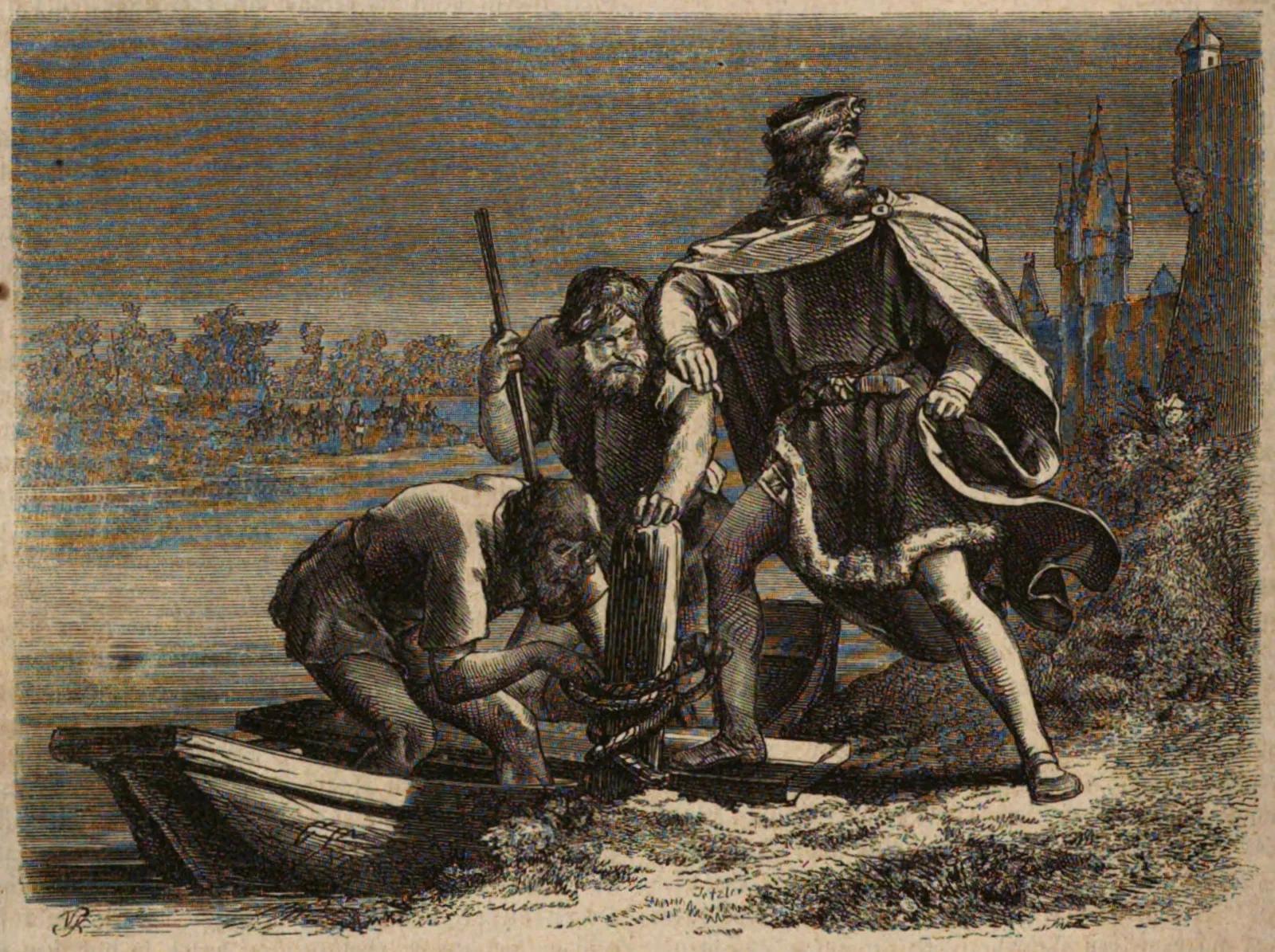
Engraving depicting Wenceslas IV in a boat scene
Wenceslas IV in a later engraving after Vinzenz Katzler (19th century) — an artistic rendering, not a period portrait. Vinzenz Katzler, Wikimedia Commons, public domain

Part V

Prague in 1412

15Indulgences: a dispute over money, faith and authority

The year 1412 is among the most dramatic in Hus’s life and in the history of the Prague reformation. The background: the church schism, which the Council of Pisa in 1409 had failed to resolve, deepened — instead of one pope there were now three. Decisive for the Bohemian lands was John XXIII, the Pisan-obedience antipope, who needed money. In 1412 he declared a crusade against King Ladislaus of Naples, his rival, and to finance it ordered an extensive sale of indulgences.

Prague became one of the places of sale. Whoever bought an indulgence received remission of the penalties for sins — in practice it was the collection of money for a war that did not concern most people. Hus rejected this sale as an abuse of church authority: in sermons and writings he argued that indulgences cannot remit what only God can remit, and that money for spiritual forgiveness is sacrilege. Against him stood the majority of the university masters, who formally defended indulgences as legitimate.

Wenceslas IV, who had a financial share in the indulgence sales and needed peace, forbade Hus to criticise the indulgences publicly. Hus complied in part but did not renounce them: the sermons from the Bethlehem Chapel continued to carry into the streets and houses, and tension in Prague grew. The indulgence dispute thereby ceased to be an academic question and became a confrontation between the city and both ecclesiastical and royal power.

16The satirical procession against the indulgences

The Prague reaction to the indulgence sales was not merely verbal. The sources preserve reports of popular unrest and satirical actions in which the indulgence sellers were publicly mocked. Best known is the tradition of a procession in which people parodied church rites; the exact form of these events, however, must be distinguished from later literary and chronicle embellishments. The unrest and public displays of contempt are documented; detailed scenarios with masks and costumes belong to later accounts.

Satirical songs and verses circulated through the city; the documented actions were not organised by Hus’s circle — they were spontaneous expressions of people who carried the criticism of the indulgences away from the Bethlehem sermons. That is precisely what matters: Hus’s preaching created in the city a public that had learned to judge and condemn church authority. The reform from the pulpit became a movement in the streets.

Out of this exchange — critical preaching, popular satire and ecclesiastical resistance — grew a situation Prague never forgot: a situation in which, for the first time in the history of a Bohemian city, the common people confronted the ecclesiastical and royal establishment — and stood its ground. For Hus, this movement also meant a personal danger that could not be avoided.

17Three young men who paid with their lives

In July 1412 the indulgence dispute came to a head. On 10 July, three young men — named in the sources as Martin, Jan and Stašek — were arrested during the protests. Their names survive, but we know little of their lives: they were men who had publicly spoken out against the sale of indulgences. The arrests reflected the pressure of the town council and church officials, who had begun to see the situation as a loss of control over the city.

The exact circumstances of the execution belong among the disputed historical questions. It is documented that the three young men were beheaded on 11 July 1412, after failed negotiations at the Old Town Hall, and that the execution took place near the town hall; the most widespread interpretation gives the place where today’s Železná Street joins the Old Town Square. Older literature sometimes works with the notion of an execution ground in the New Town; the sources offer several versions and none can be conclusively confirmed.

The execution caused shock. Prague saw that church and municipal power were willing to use force against ordinary people who had spoken out against the indulgences. Hus responded publicly: he named the three dead as martyrs, and according to the sources their bodies were carried to the Bethlehem Chapel, where supporters of the reform buried them with solemnity. The chapel thus became the first Hussite memorial tomb, and the three young men entered history as the first martyrs of the Hussite movement.

The significance of the event exceeds any single report. It showed the powerful that the reform movement had a radical wing too and could not be ignored; Hus’s position became visible to the whole kingdom. It was the first blood the indulgence dispute demanded — and tradition said it would not be the last.

18Prague under the threat of interdict

The consequences came quickly. The church authorities pronounced excommunication — exclusion from the church — on Hus, and the threat of an interdict, that is a ban on church services for the whole city, fell on all of Prague. In the Middle Ages an interdict was no small matter: in practice it meant the loss of public church services — masses, weddings and burials — for the entire community, and was therefore unbearable for the urban elites. Prague was thus forced into a position in which it had to weigh loyalty to the church against its interest in peace and order for its own people.

Hus understood the situation. So as not to deprive the city of the sacraments, he left Prague in the autumn of 1412 and went to southern Bohemia, where nobility sympathetic to the reform movement gave him protection. In exile he worked as a preacher and writer: here his principal works took shape, in which he formulated his teaching on the church and on personal conscience. He later returned to Prague — reports of his appearances survive in the sources — but his Prague years as a preacher were drawing to a close.

The interdict and the excommunication were not merely legal categories but instruments that divided Prague into supporters and opponents of Hus. Prague thus gained its first experience of the fact that the reformation could not be squeezed into the old framework — and that experience led it to the radical decisions that would manifest themselves seven years later, when the Praguers threw the councillors out of the windows of the town hall.

Part VI

Departure and Constance

19Hus leaves Prague

The autumn of 1412 meant the end of Hus’s Prague ministry. He left for southern Bohemia, where the reform-minded nobility gave him protection: he worked at Kozí Hrádek and at Krakovec. It was a period of unexpected creative fertility: here arose Hus’s principal Latin works on the church (De ecclesia) and on simony, but also Czech writings and sermons. In the south he preached through villages and small towns, from which his name spread across the whole kingdom.

Contact with his Prague supporters did not break off. Hus maintained a correspondence, received news from Prague and returned — reports of his secret and public appearances in Prague in 1413–1414 are documented. Leaving the Bethlehem Chapel did not mean an interruption but a transformation: the Prague preacher was becoming the spiritual leader of a kingdom-wide reformation who communicated through written texts and the nobility’s messenger network.

Hus himself was aware that his presence in Prague complicated the city’s life — it was Prague that bore the weight of the interdict. His departure was therefore also a personal choice: better to leave than to let Prague go without the sacraments on account of his name. Precisely this sense of collective responsibility is telling — and at Constance it would turn into a fateful decision.

20The journey to Constance

The Council of Constance, opened in the autumn of 1414, was summoned by Pope John XXIII at the urging of Sigismund of Luxembourg, King of the Romans and brother of Wenceslas IV. Its aims were three: to end the church schism, to reform the church "in head and members", and to resolve the question of heresy. For Hus it was an opportunity: a public hearing where he could defend his teaching before the whole church, not before local opponents.

Sigismund issued Hus a letter of safe conduct — a document guaranteeing him a safe journey to the council, free residence and the journey back. Its precise legal meaning must be stated: it was a ruler’s guarantee, not the council’s, and the council did not consider itself bound by it. Hus set out in the autumn of 1414 and arrived in Constance on 3 November. Barely a month later, on 28 November, he was arrested on the basis of a church order, without regard to the safe conduct, and imprisoned.

The church trial against Hus dragged on for months. The main points of contention remained: Hus refused to renounce statements of which he was convinced they accorded with Scripture, and he did not consider a complete recantation of his teaching possible. The council, on the contrary, demanded an unconditional retraction — not different formulations, but complete renunciation. This asymmetry created a situation with no honourable way out: either betrayal of one’s own conscience, or death.

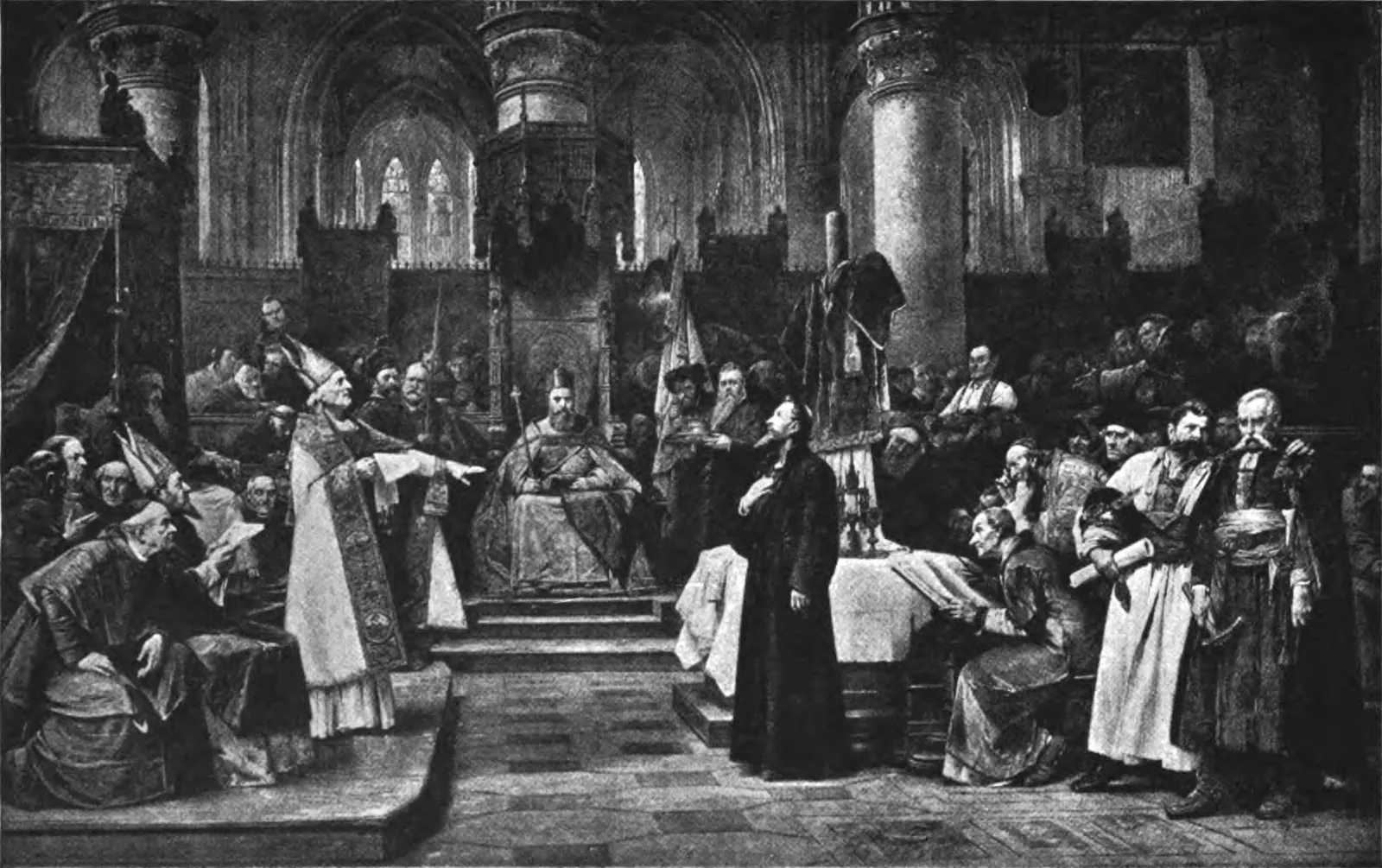
Painting of Jan Hus at the Council of Constance by Václav Brožík
Jan Hus before the Council of Constance, a painting by Václav Brožík (19th century). It is a later artistic rendering — Brožík’s idea of a scene for which no contemporary picture survives. Václav Brožík, Wikimedia Commons, public domain

21The last days of Jan Hus

After his arrest Hus was held in the Dominican monastery in Constance, and from December 1414 at Gottlieben Castle by the lake. The interrogations dragged on for months: his positions were summarised into articles against which the church theologians spoke. Hus, ill and imprisoned, refused to recant: he would retract only if they proved him wrong — from Scripture, not by the decision of an office.

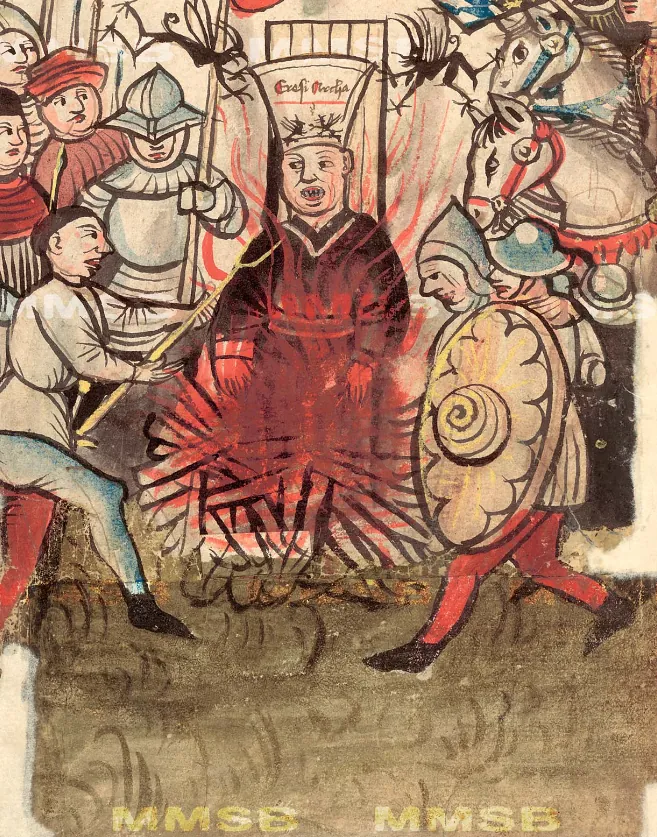
On 6 July 1415 the council delivered its verdict: Hus was condemned as an obstinate heretic, stripped of his priestly office and handed over to the secular power for the sentence to be carried out. At the ceremony his vestments were formally stripped from him and his writings burned. Outside the walls of Constance he was burned at the stake that same day; his ashes were scattered into the Rhine so that no place of veneration would remain. A year later, on 30 May 1416, Jerome of Prague shared his fate.

Historians argue to this day over the legal and moral aspects of the trial: the council proceeded by its own rules, Sigismund’s safe conduct was disregarded, and Hus was denied the kind of judicial defence he knew from university disputations. It was not a miscarriage of justice but a deliberate suppression of the reform movement. Yet the consequences exceeded all expectations: instead of calming the movement, the death gave it a martyr and a symbol — the chalice.

Contemporary depiction of the burning of Jan Hus from Richenthal’s chronicle
The burning of Jan Hus in the chronicle of the Council of Constance (the so-called Richenthal chronicle, Prague manuscript). It is the nearest surviving contemporary depiction of the event. Ulrich von Richenthal (Chronicle of the Council of Constance), Wikimedia Commons, public domain

Part VII

Prague After Hus’s Death

22How Prague received the news from Constance

News of Hus’s death spread through Prague quickly. The reformist community received it as the suffering of a just man; the city that remembered Hus as a preacher realised it had lost the most distinctive voice of its age. The reaction was not merely symbolic: the University of Prague, dominated by the Bohemian nation since the Decree of Kutná Hora, took up Hus’s legacy and condemned the council’s conduct.

The stance of the nobility was fundamental. In 1415–1417 the Bohemian and Moravian nobility sealed protest letters in which they spoke out against the burning of Hus and Jerome of Prague and against the council’s proceedings. It was an unprecedented collective act: hundreds of noble seals confirmed that Hus’s death was not a private matter but the affair of an entire country.

Prague thereby entered a position with no firm centre: King Wenceslas was dying, Sigismund claimed the throne, and the church hoped the situation could be managed. Religious tension was becoming the basis of political organisation: the reform movement gained the nobility, the university, the city and the priesthood. It was in this situation that the chalice, the symbol of communion in both kinds, began to mean more than a liturgical question — it became the sign of a movement that was turning into a revolution.

23The Church of St Martin in the Wall and the chalice

The chalice — communion in both kinds, that is in the form of bread and wine also for laypeople — became the Hussite symbol, but its introduction in Prague was not Hus’s doing. At its head stood Jakoubek of Stříbro, Hus’s pupil and preacher at the Church of St Martin in the Wall in the Old Town. At the end of 1414, while Hus was still alive, communion in both kinds was, according to the most commonly cited dating, first administered to laypeople in Prague in this church on 26 November.

Hus took a more reserved stance on the introduction of the chalice — he counselled caution so that the new practice would not cause a schism. It was thus an initiative of Jakoubek and his circle, not a command of Hus. This matters: Hussitism was not the affair of a single man but a network of preachers, masters and communities that decided on a new practice. The chalice quickly became a visible sign — after it the movement also called itself the party of the chalice.

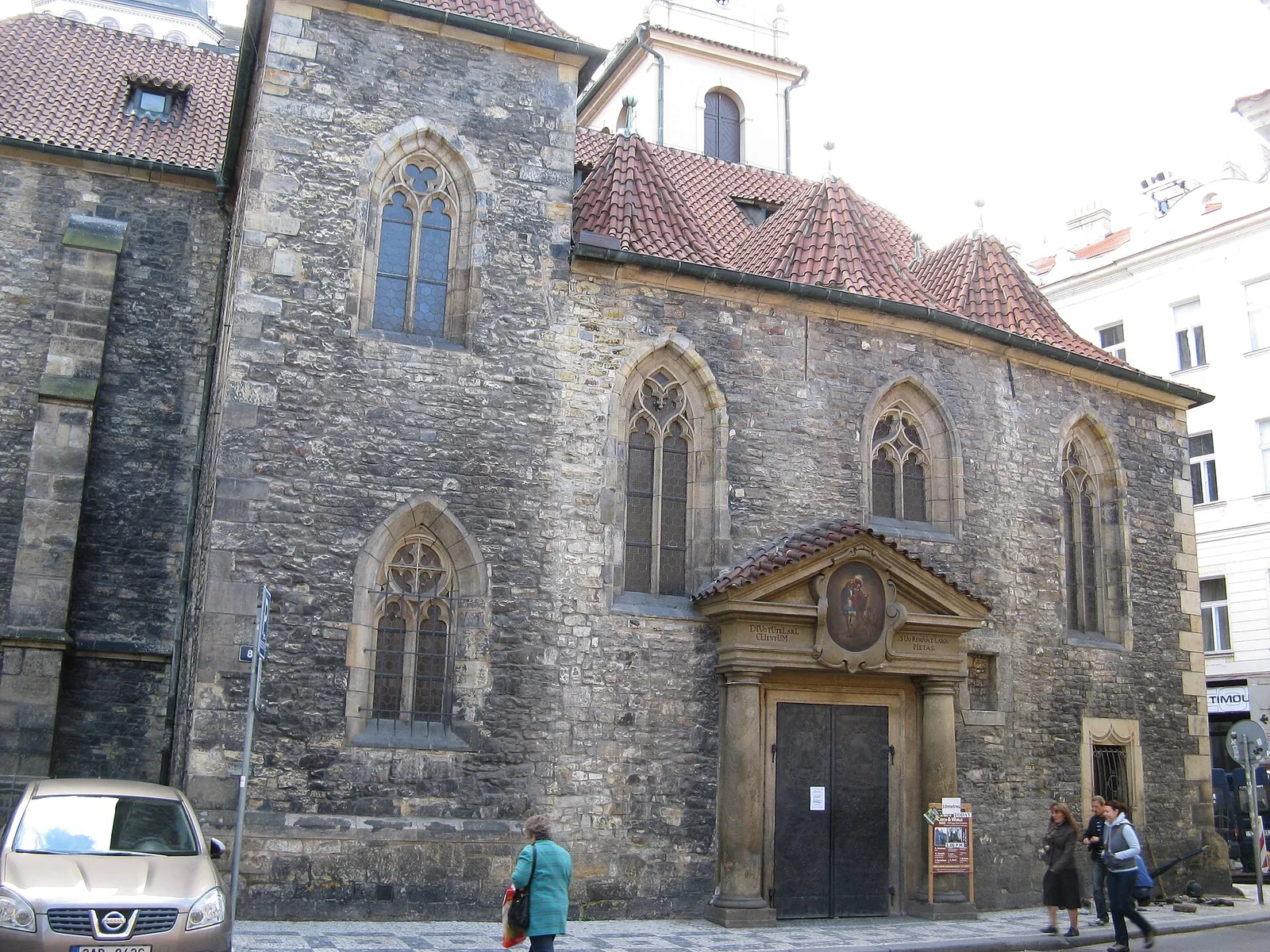
The Church of St Martin in the Wall stands in Martinská Street and belongs to the oldest surviving sacred buildings in Prague; its name refers to its position by the walls of the time. Today it serves as an evangelical church and its space is open to the public; the visitor will see Romanesque and Gothic masonry at the place where a liturgical experiment began that became the beginning of a revolution.

The Church of St Martin in the Wall in Martinská Street
The Church of St Martin in the Wall, where Jakoubek of Stříbro introduced communion in both kinds at the end of 1414. Photo: Yair Haklai, Wikimedia Commons, CC BY-SA 4.0

24Jan Želivský and the radicalisation of Prague

After Hus’s death the Prague reformation took on a more radical character. The key figure became Jan Želivský, preacher at the Church of Our Lady of the Snows near Jungmann Square. Želivský was a master, but above all a popular preacher who could connect religious criticism with the social: he spoke to the poor, to craftsmen and to small burghers who saw the church and the town administration as a system of the privileged.

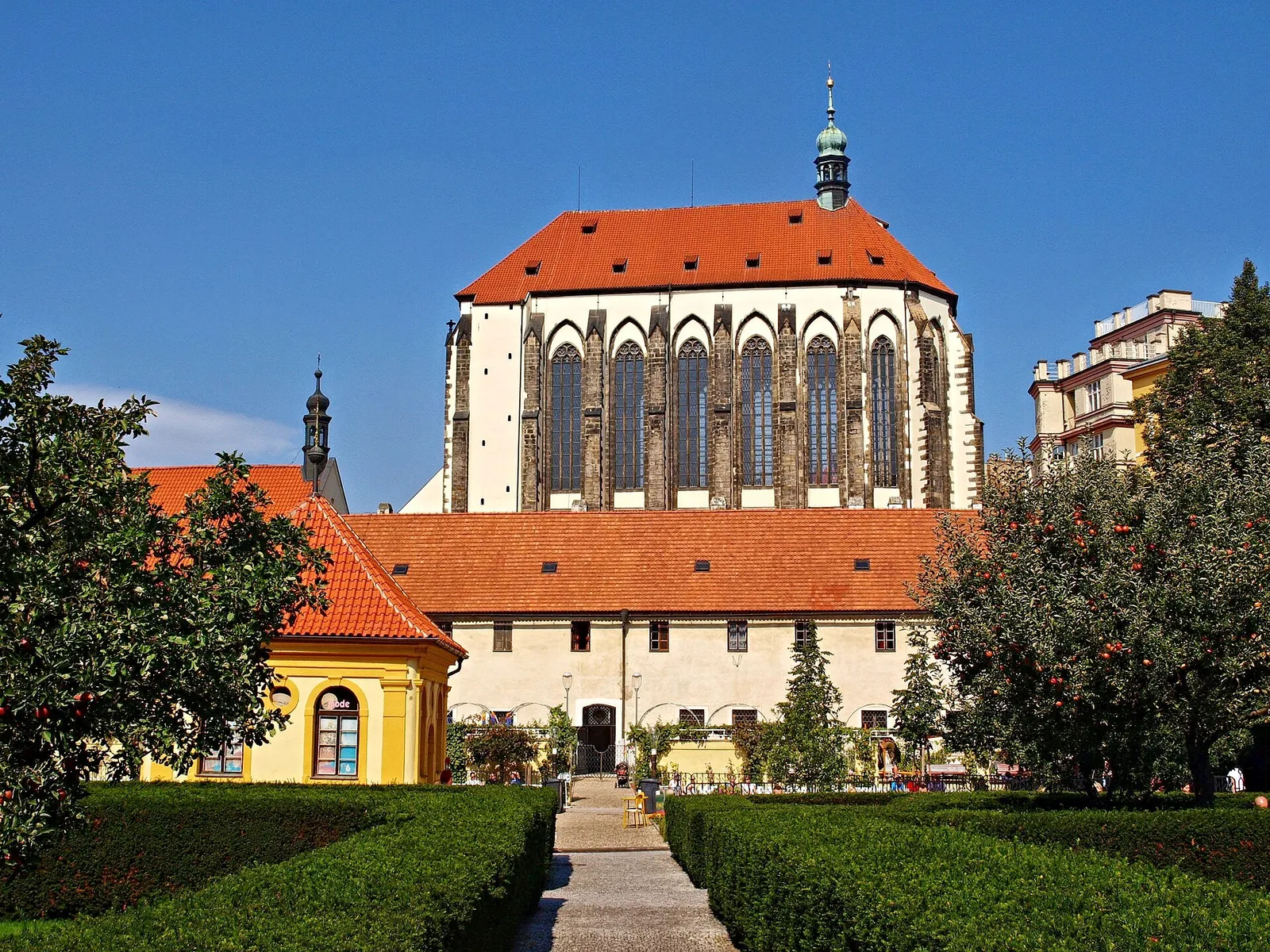
The Church of Our Lady of the Snows remains a striking landmark of the neighbourhood: a massive Gothic church that was never completed — its original plan exceeded the dimensions that were finally built. Today it serves the Franciscans and its interior is open to the public; the vertical, unusually tall space preserves the atmosphere of the place where Želivský’s sermons drew thousands.

Želivský’s significance lies in the transformation of the reformation from a spiritual movement into a political force. Prague’s urban community was dividing not only by confession but by interests: tax and property disputes became intertwined with religious ones. When in 1419 the crisis of government, social tension and religious radicalisation converged, Prague became a city that decided to stand up for itself — and Hus’s legacy took on another, unexpected form.

The Church of Our Lady of the Snows from the Franciscan Garden
The Church of Our Lady of the Snows, where Jan Želivský preached. The church was never completed according to its original plans; to this day it is distinguished by its unusually high hall interior. Photo: VitVit, Wikimedia Commons, CC BY-SA 4.0

25The first Prague defenestration, 1419

On 30 July 1419 an event took place that is regarded as the beginning of the Hussite wars. Želivský’s procession, which after a sermon set out for the Old Town and then for the New Town Hall, demanded the release of the imprisoned preachers. When the councillors refused, the crowd broke into the building and threw the councillors — members of the town council — out of the windows of the council hall. Some died in the fall, others were beaten to death on the spot; the figures for the numbers differ in the sources.

Radical Praguers from Želivský’s circle took part in the action; the exact names of the actors have not survived, and later narratives about individual participants belong to legend. What matters is the political consequence: the New Town passed into the hands of the Hussite community and the town hall became its seat. Prague found itself in conflict with ecclesiastical power and with the heir to the throne alike.

King Wenceslas IV did not survive the event: on 16 August 1419 he died at Kunratice Castle, probably of a stroke, reportedly at the moment when he learned of the defenestration. The exact connection cannot be documented; it is certain, however, that with his death ended the last reign that could have understood Hussite Prague. The throne was claimed by Sigismund, who stood on the opposite side of the Hussite legacy — and the Hussite revolution entered open conflict.

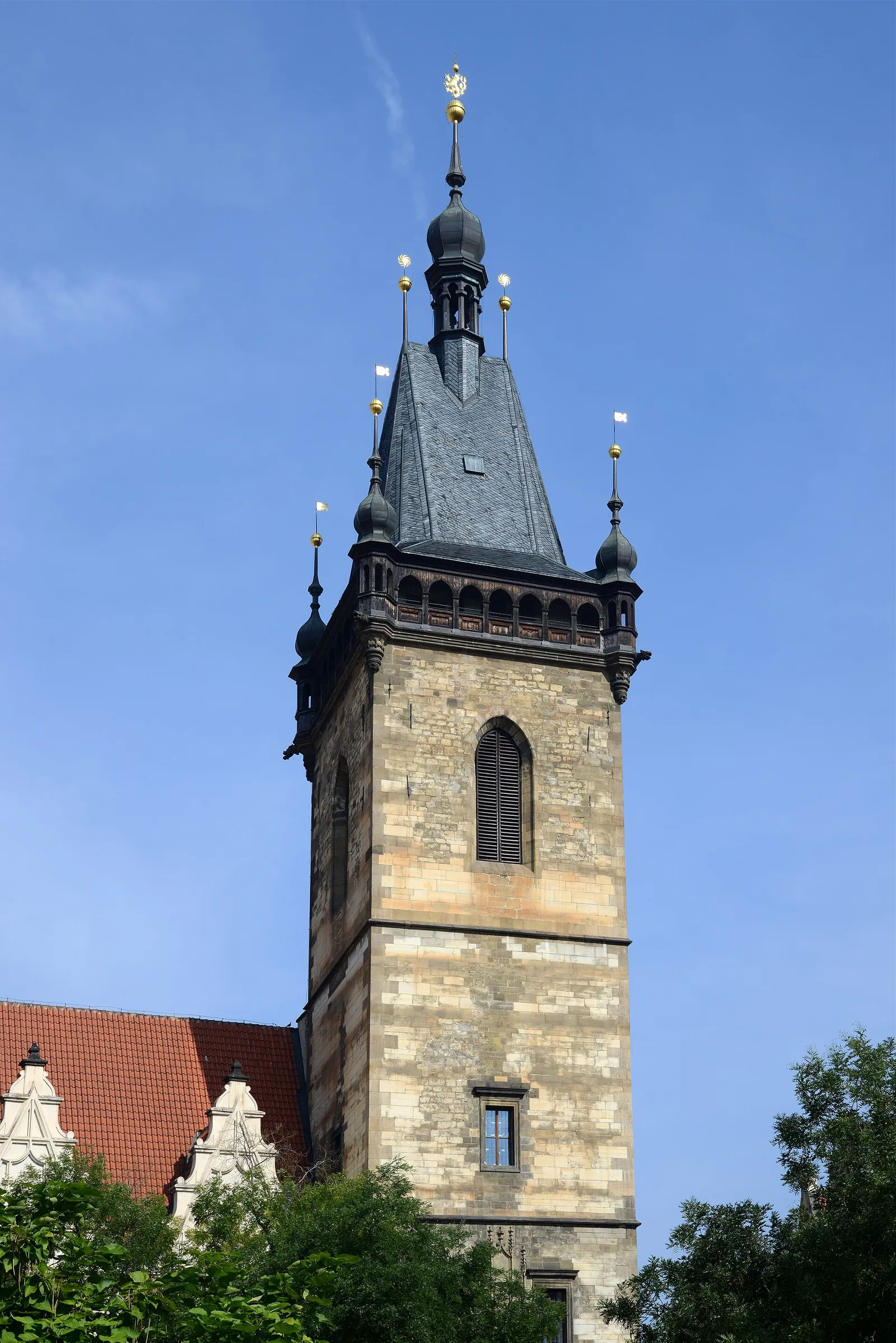
The tower of the New Town Hall on Charles Square
The New Town Hall with its Gothic tower, the site of the first Prague defenestration of 30 July 1419. Today the building houses the Prague city administration; the hall of the defenestration is accessible within the open exhibitions. Photo: Alvesgaspar, Wikimedia Commons, CC BY-SA 4.0

26Prague during the Hussite wars

The Hussite wars transformed Prague. The Old Town and the New Town, once rivals, became Hussite strongholds — each with its own council, its own troops and its own policy. Disputes arose between the urban currents, and between Prague and the more radical Taborite movement; Prague represented the moderate line, Tábor a radical communal experiment. Leadership of the military resistance was taken over by Jan Žižka of Trocnov, an experienced soldier who joined the reformation and became its most capable commander.

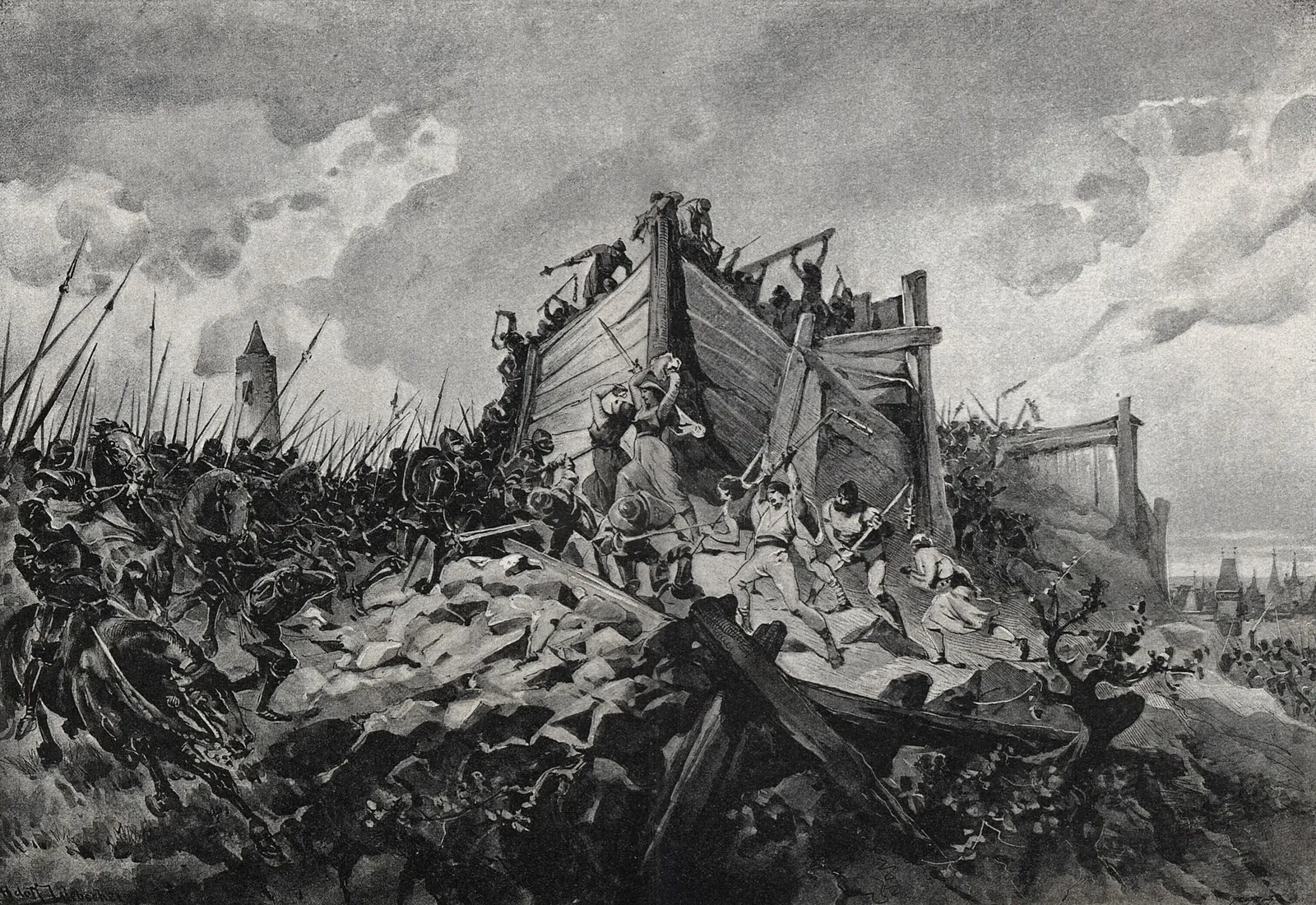
In 1420 Sigismund set out with a crusade to conquer Prague. On 14 July 1420 the battle that decided the city’s fate was fought at Vítkov — the hill above the then New Town, today Žižkov. A small garrison — the sources speak of only a few dozen fighters under Žižka’s command — withstood the assault of the foreign and domestic troops and saved the city. The victory at Vítkov became a symbol of Hussite defence and showed that the revolution knew how to defend itself.

The history of Hussite Prague is also captured by period artefacts: the Jeníkov Codex, an illuminated manuscript from the early 15th century, contains the well-known depiction of Hussite warriors; one of the fighters is traditionally identified with Jan Žižka, though this is a later interpretation, not a documented portrait. Prague was transformed from a reformist city into a military and political centre that influenced Central Europe with its army and its diplomacy alike. The Hussite revolution thereby became a European phenomenon — and the European church had to learn to reckon with it.

Painting of the Battle of Vítkov by Adolf Liebscher
The Battle of Vítkov Hill on 14 July 1420, a painting by Adolf Liebscher (19th century). It is a later artistic rendering, not a contemporary depiction of the battle. Adolf Liebscher, Wikimedia Commons, public domain

Part VIII

How Prague Remembers Jan Hus

27The Hus Monument on the Old Town Square

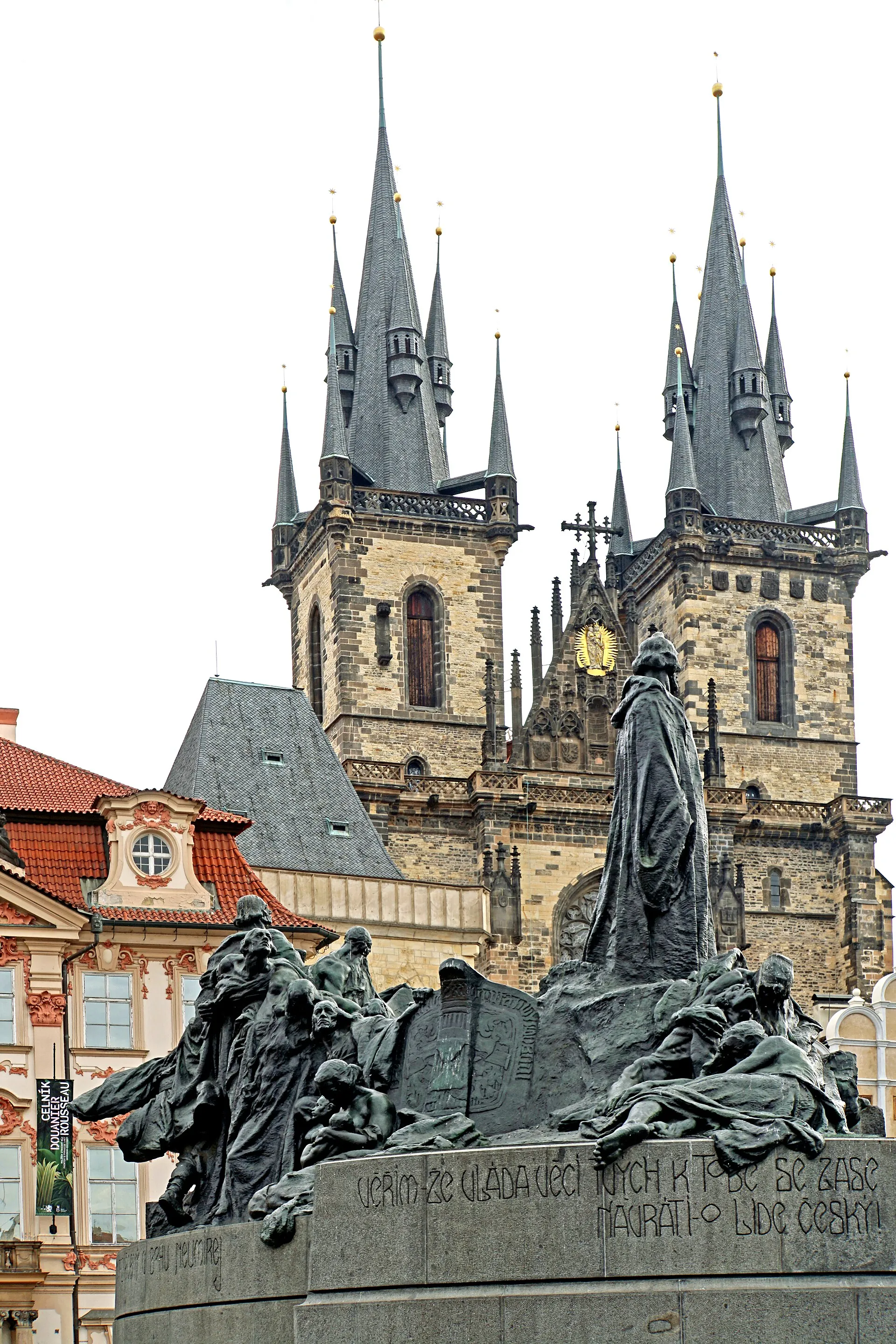
Prague built Hus a monument that today belongs to the best-known sculptures in the city. In the competition announced at the turn of the 20th century the design of the sculptor Ladislav Šaloun prevailed; the monument was completed and unveiled on 6 July 1915, exactly five hundred years after Hus’s burning. Because of the war, in which the Bohemian lands belonged to the Austro-Hungarian monarchy, the unveiling took place without the public — without a ceremonial procession, only as a quiet, private event.

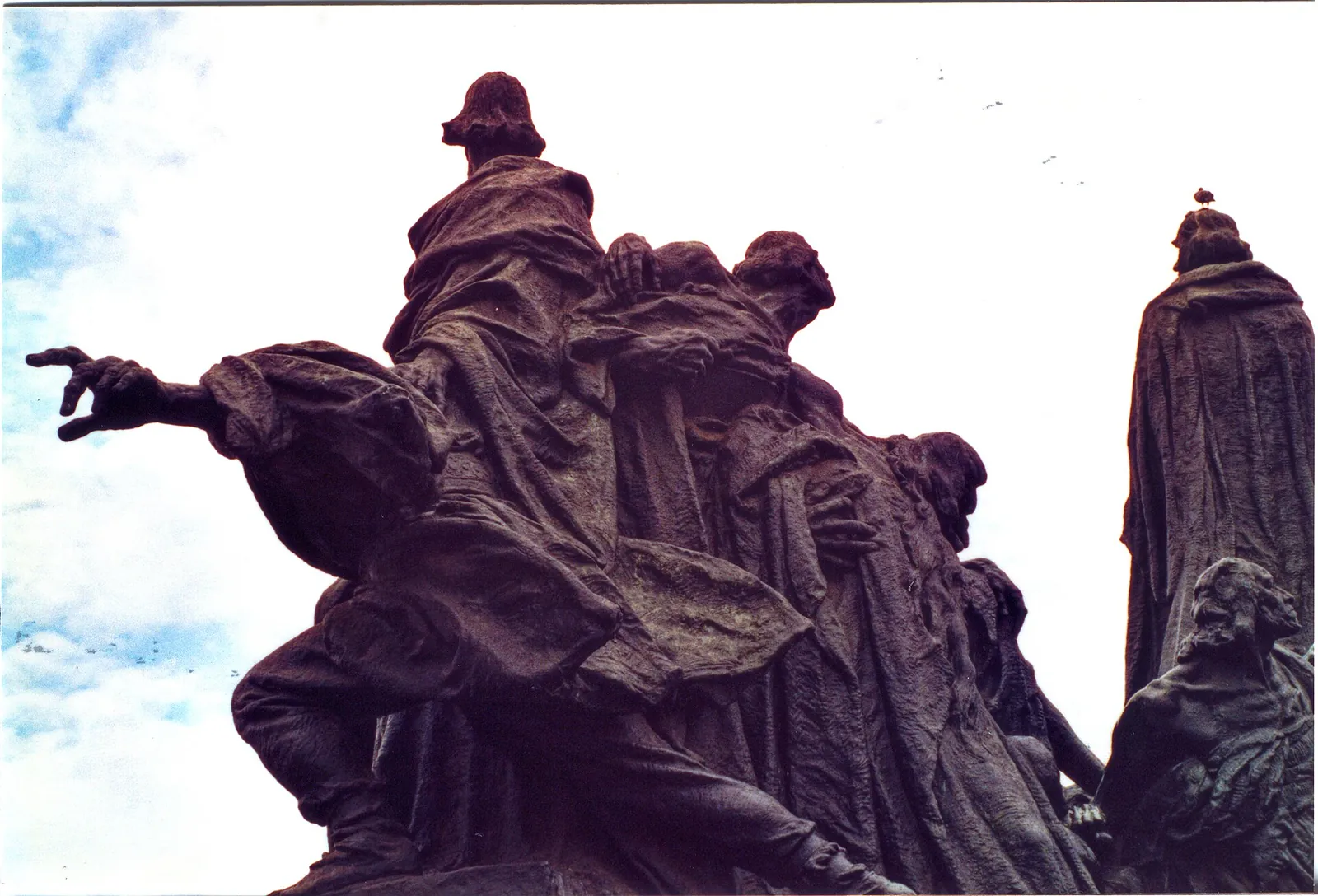
The sculpture group is not only a monument to one man. At its centre stands Hus as a preacher; around him are figures that tell of his legacy: a Hussite victor on one side, a young mother with a child and an exile on the other — a reference to the exile into which thousands of Bohemian non-Catholics went after the Battle of White Mountain. It is a composition that can be read as the history of a nation: victory, defeat, departure, remembrance.

The Hus Monument has passed through the same changes of interpretation as Hus himself. It was a site of First-Republic demonstrations, a symbol of resistance during the Nazi occupation, and an instrument of regimes that wanted to use it for their own purposes. Today it stands on the Old Town Square as a reminder that the places where history is decided tend to stay alive — and that the Hussite legacy is still present in Prague.

Detail of the Hus Monument by Ladislav Šaloun
Detail of the Hus Monument group: the figure of Hus and the figures that tell of his legacy — victory, exile, remembrance. Photo: Txllxt TxllxT, Wikimedia Commons, CC BY-SA 4.0

28Jan Hus in the era of the national revival

At the end of the 18th century and in the 19th century Hus became a symbol of the Czech national movement. Historians and writers of the revival — František Palacký at their head — interpreted Hussitism as the historic victory of the Czech spirit over German power and the church hierarchy. It was an interpretation with many disputable points, but extraordinary power: Hus ceased to be merely a theological heretic and became a national hero.

The revival appropriated Hus into cultural memory: monuments, societies, writings and songs were created. Hus became a name that served to mobilise the nation; his moral integrity became part of the national culture. The significance of this development is twofold: it preserved the Hussite legacy, but at the same time reshaped it into a national symbol that was hard to reconcile with Hus’s original religious conviction.

It was from this development that the competition for the Hus Monument and its realisation in 1915 grew. Hus thus symbolically returned to the Old Town Square — to the place that shaped his Prague story — as an expression of national continuity. To remember Hus as a theologian, reformer and martyr therefore also means remembering the layers of interpretation that have accumulated over his legacy.

29Jan Hus in the 20th century

The First Republic appropriated Hus as one of the icons of national culture. In 1920 the Czechoslovak Hussite Church was founded, a reformist community building on the Hussite legacy; Hus became part of the state’s iconography. The Hussite legacy thereby gained a new political and cultural standing, but also a new risk: it became part of state mythology.

During the Second World War and under communism Hus was used for interpretations that did not fit him. Nazi propaganda recast him into the pattern of an anti-German struggle; communist ideology made him a precursor of the revolutionary Taborite movement and of social revolution. These interpretations either passed over Hus’s religious dimension in silence or reshaped it. The sculpture group on the Old Town Square, built under the monarchy, became a mute witness of all the regimes.

After 1989 more balanced interpretations prevailed. Hus is today understood above all as a preacher and theologian who took the side of conscience and the criticism of institutions, not as an ideological symbol. Research on Hussitism is rich and international; the Prague places where Hus worked are today understood as part of the European heritage of the reformation. Hus Day, 6 July, has been a public holiday since 2000 (the Day of the Burning of Master Jan Hus).

30What Jan Hus means today

Hus’s significance is easier to grasp today once we set aside the exaggerated national and political interpretations. He was not the founder of modern democracy or of Protestantism — such simplifications do not give correct history. But he was the first great Czech voice to declare that personal conscience stands above the duty of obedience to institutions, and that criticism of the powerful is a moral duty, not an offence.

His legacy has several layers. The religious one: Hussitism and the later tradition of the Unity of the Brethren continued the reform movement that became part of the European reformation. The cultural one: Hus’s contribution to Czech literature and language is lasting — his sermons and writings shaped Czech as a language of learning and spiritual life. The political one: the Hussite revolution showed that religious criticism can turn into the civic and social transformation of society.

For the visitor to Prague, Hus’s story has one concrete dimension: it is the story of a city. The Bethlehem Chapel, the Church of St Martin in the Wall, the Old Town Square, the Church of Our Lady of the Snows, the New Town Hall — these are not only monuments but places where the events took place. Whoever walks through them will understand that Prague is not only a Gothic gem but a city where history was decided — and where the Hussite revolution began.

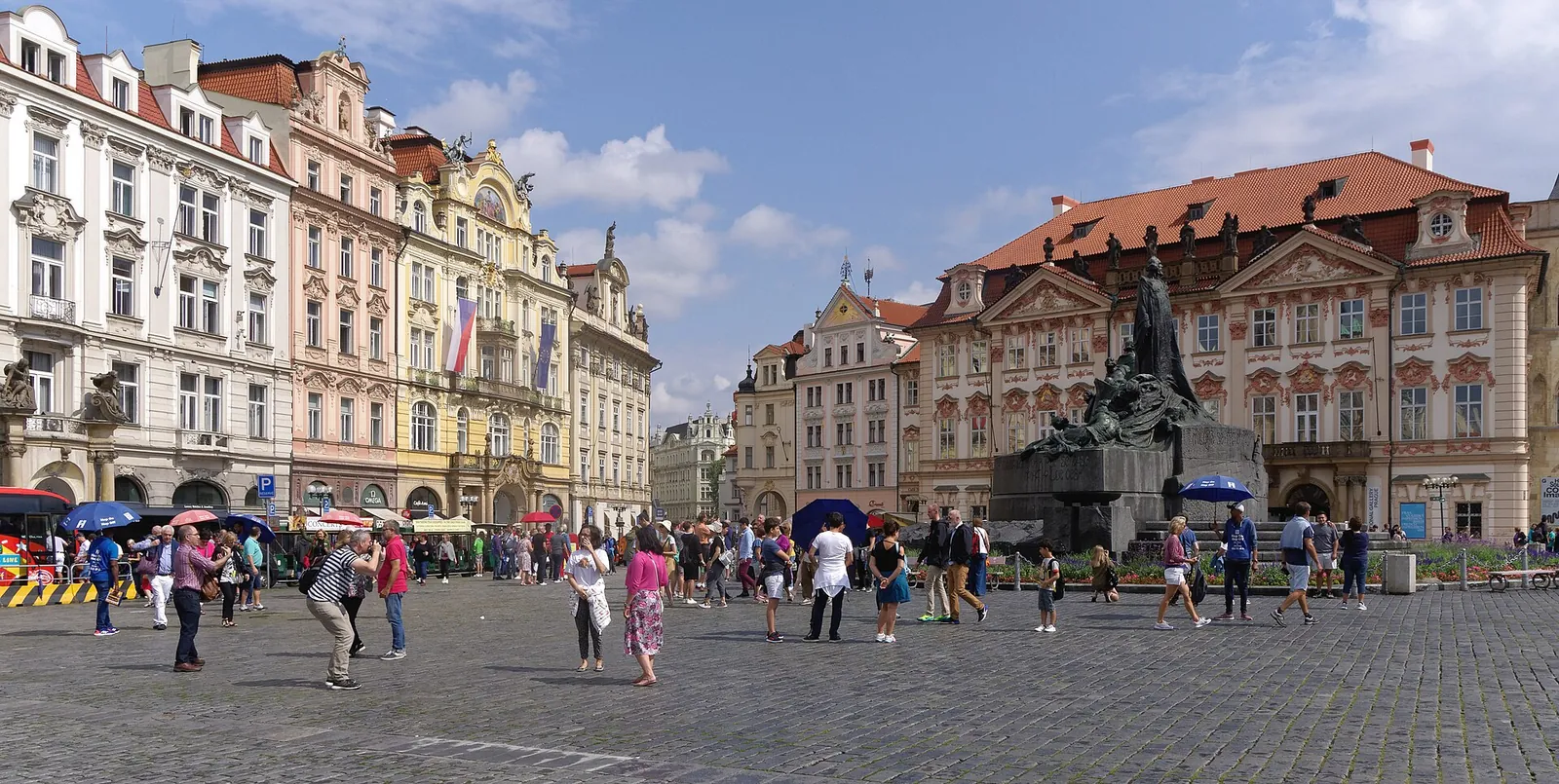
The Old Town Square with the Hus Monument
The Old Town Square today: the Hus Monument in the centre, the Church of Our Lady before Týn behind. A place that to this day remembers Hus’s story. Photo: Jakub Hałun, Wikimedia Commons, CC BY-SA 4.0

Timeline

Ten dates that transformed Prague and the whole Bohemian kingdom.

  1. 1348

    The university is founded

    Charles IV founds the Prague studium, the first university in Central Europe. Read the chapter →

  2. 1391

    The Bethlehem Chapel is founded

    Jan Kříž and Hanuš of Mühlheim found a chapel for preaching in Czech. Read the chapter →

  3. 1402

    Hus begins to preach in the Bethlehem Chapel

    Hus becomes the preacher of the Bethlehem Chapel; before that he had preached at St Michael’s. Read the chapter →

  4. 1409

    The Decree of Kutná Hora

    Wenceslas IV gives the Bohemian nation three votes; the foreign masters leave. Read the chapter →

  5. 1410

    The burning of Wycliffe’s books

    Archbishop Zbyněk has the confiscated Wycliffite writings burned in the Lesser Town. Read the chapter →

  6. 1412

    The indulgence crisis

    The sale of indulgences, protests, the execution of three young men on 11 July. Read the chapter →

  7. 1415

    Hus dies at Constance

    The council condemns Jan Hus; on 6 July 1415 he is burned outside the walls of Constance. Read the chapter →

  8. 1419

    The first Prague defenestration

    On 30 July 1419 the Praguers throw the councillors out of the windows of the New Town Hall. Read the chapter →

  9. 1420

    The Battle of Vítkov

    On 14 July 1420 the Prague garrison under Žižka’s command repels the crusader assault. Read the chapter →

  10. 1915

    The Hus Monument

    The sculpture by Ladislav Šaloun is unveiled on the Old Town Square. Read the chapter →

Then and Now

Hus’s Prague and today’s city — what remains and what has changed.

A Walk in the Footsteps of Jan Hus

Seven stops in the centre of Prague. The route crosses the Old and New Town, roughly two kilometres, all walkable. Each stop has its own chapter above.

  1. The Karolinum courtyard
    The Karolinum courtyard, the historic seat of Charles University. Photo: David Short, Wikimedia Commons, CC BY 2.0

    11348–1390s

    The Karolinum

    Ovocný trh 3, Staré Město, Praha 1

    The seat of the University of Prague, where Hus studied, taught, and served as rector in 1409–1410.

    The Karolinum is the historic heart of the Prague studium. The young Jan Hus from Husinec came here, here he passed his bachelor’s and master’s examinations, and here he later taught at the Faculty of Arts. The elites of Central Europe were formed at the Karolinum — and it was precisely here that the academic disputes over Wycliffe were born that foreshadowed the Hussite revolution.

    In 1409–1410 Hus was elected rector of the university, the highest academic office. From the Karolinum came the protest against the burning of Wycliffe’s books and the support the university gave to Hus’s legacy.

    Today: The Karolinum is today the seat of Charles University. The university precinct by the Fruit Market is partially accessible; from the centre you reach it on foot from the Old Town Square.

    Show on map →
  2. Depiction of Jan Hus
    Jan Hus in a later woodcut (16th century); no likeness from his lifetime has survived. Sebastian Münster, Wikimedia Commons, CC0

    2c. 1402

    Michael Street — the site of the church of St Michael

    Michalská 16, Staré Město, Praha 1

    The Dominican monastic church where Hus preached before coming to the Bethlehem Chapel.

    Hus’s first documented preaching position in Prague was at St Michael, the Dominican monastic church in the Old Town. It was a typical first pulpit for a young priest, giving him contact with an urban audience — and at the same time the first public arena where his criticism of church conditions was heard.

    The church has not survived to the present day in its original form: under the Josephine reforms of 1786 it was dissolved. The site is today part of the Dominican monastic block known as the monastery of St Giles; the medieval masonry can be found in the street block between Michalská and Jilská.

    Today: Michael Street is part of the Old Town pedestrian zone. The original church of St Michael stood near the present church of St Giles; only the perimeter wall of the church has survived.

    Show on map →
  3. The Old Town Square with the Hus Monument
    The Old Town Square with the Hus Monument and the Church of Our Lady before Týn. Photo: Jakub Hałun, Wikimedia Commons, CC BY-SA 4.0

    31412 · 1915

    The Old Town Square — the Hus Monument

    Staroměstské náměstí, Staré Město, Praha 1

    The Hus Monument by Ladislav Šaloun (1915); according to the prevailing tradition also the site of the execution of the three young men (1412).

    The Old Town Square is connected with Hus’s story twice. In 1412 — according to the most widespread interpretation where today’s Železná Street joins the square, other versions speak of other places — the town council, after failed negotiations, had three young men executed here: Martin, Jan and Stašek, who had spoken out against the sale of indulgences. Hus called them martyrs, and according to the sources supporters of the reform buried them in the Bethlehem Chapel.

    In 1915, exactly five hundred years after Hus’s burning, the Hus Monument by Ladislav Šaloun was unveiled here. The sculpture group — Hus, a Hussite victor, an exile and a mother with a child — turned the square into a place of national remembrance.

    Today: The monument stands in the centre of the square and is freely accessible. From the Old Town Hall there is a view over the whole square and the Church of Our Lady before Týn.

    Show on map →
  4. The Church of St Martin in the Wall
    The Church of St Martin in the Wall, the place of the first chalice in Prague. Photo: Yair Haklai, Wikimedia Commons, CC BY-SA 4.0

    41414

    The Church of St Martin in the Wall

    Martinská 8, Staré Město, Praha 1

    The place where, at the end of 1414, Jakoubek of Stříbro first introduced communion in both kinds.

    The chalice became the Hussite symbol, but it was not introduced by Hus. The initiator was Jakoubek of Stříbro, Hus’s pupil and preacher at St Martin in the Wall. At the end of 1414 — while Hus was still alive — communion in both kinds, bread and wine, was for the first time in Prague administered to laypeople here, according to the most commonly cited dating.

    The chalice quickly became the visible sign of the movement. The Church of St Martin in the Wall belongs to the oldest surviving sacred buildings in Prague; its name refers to its position by the walls of the time.

    Today: The church today serves an evangelical congregation and its space is open to the public. The visitor will see Romanesque and Gothic masonry in the historic buildings between the Old Town Square and Národní třída.

    Show on map →
  5. The Bethlehem Chapel from the outside
    The Bethlehem Chapel in Bethlehem Street, Hus’s principal pulpit. Photo: Kf, Wikimedia Commons, public domain

    51391 · 1402–1412

    The Bethlehem Chapel

    Betlémské náměstí 255/4, Staré Město, Praha 1

    Hus’s pulpit, where Prague listened to his sermons for years.

    The Bethlehem Chapel was founded in 1391 for preaching in Czech, and from 1402 Hus made it the centre of the reform movement. Here he preached on Scripture, on the morals of the clergy and on the responsibility of the powerful. Here the reformation turned from a university disputation into a public movement.

    Today the chapel is open, and its space commemorates the place where the Hussite movement took shape. From outside you can see the surviving fabric of the Gothic building; inside are paintings with song texts and biblical quotations — the work of the modern reconstruction of 1950–1954.

    Today: The chapel belongs to the Evangelical Church of Czech Brethren and is open to the public; information on admission and opening hours is best checked on the local websites.

    Show on map →
  6. The Church of Our Lady of the Snows
    The Church of Our Lady of the Snows, the pulpit of Jan Želivský. Photo: VitVit, Wikimedia Commons, CC BY-SA 4.0

    6from 1419

    The Church of Our Lady of the Snows

    Jungmannovo náměstí 18, Nové Město, Praha 1

    The pulpit of Jan Želivský, the radical preacher of Hussite Prague.

    After Hus’s death the Prague reformation took on a radical character. The key figure became Jan Želivský, preacher at Our Lady of the Snows, who connected religious criticism with the social: he spoke to the poor, to craftsmen and to small burghers.

    Želivský’s sermons drew thousands. From the Church of Our Lady of the Snows the processions also set out which on 30 July 1419 ended at the New Town Hall with the first Prague defenestration — the event with which the Hussite wars began.

    Today: The church today serves the Franciscans and is freely accessible. Its unusually tall interior recalls the plan that was never completed.

    Show on map →
  7. The tower of the New Town Hall
    The New Town Hall with its Gothic tower, the site of the defenestration of 1419. Photo: Alvesgaspar, Wikimedia Commons, CC BY-SA 4.0

    730 July 1419

    The New Town Hall

    Karlovo náměstí 22, Nové Město, Praha 2

    The site of the first Prague defenestration, the beginning of the Hussite revolution.

    On 30 July 1419 Želivský’s procession brought to the New Town Hall the demand to release the imprisoned preachers. When the councillors refused, the crowd threw them out of the windows of the hall. The event meant the seizure of power in the New Town by the Hussite community and is usually regarded as the beginning of the Hussite wars.

    King Wenceslas IV did not survive the event: on 16 August 1419 he died at Kunratice Castle. With his death ended the last reign that could have understood Hussite Prague.

    Today: The New Town Hall is the seat of the Prague city administration; the historic rooms, including the place of the defenestration, are accessible on guided tours and open days. The tower offers a view over Charles Square.

    Show on map →

Did You Know?

Five facts that turn familiar ideas upside down.

The chalice was not Hus’s idea

Communion in both kinds was introduced in Prague by Jakoubek of Stříbro at the Church of St Martin in the Wall at the end of 1414 — while Hus was still alive. Hus took a more reserved stance on the new practice and counselled caution.

Prague lost thousands of students

After the Decree of Kutná Hora of 1409 the foreign masters and students left Prague; at their urging the University of Leipzig was founded in 1409.

The safe conduct did not protect him

The letter of safe conduct from Sigismund of Luxembourg was a ruler’s guarantee, not the council’s. Hus was arrested on 28 November 1414, barely a month after arriving in Constance.

Ashes into the Rhine

The council had Hus’s ashes scattered into the Rhine so that no place of veneration would remain. The place of memory thus remained not in Constance but in Prague.

The monument was unveiled quietly

The Hus Monument was unveiled on 6 July 1915, exactly five hundred years after the burning — but because of the ongoing war without a public procession, only in a small circle.

FAQ

Answers to the questions visitors ask most about Hus and Prague.

Where did Jan Hus preach in Prague?

Hus preached above all in the Bethlehem Chapel in the Old Town, where he served from 1402. Before that he preached at the Dominican monastic church of St Michael in Michael Street.

Where did Jan Hus live in Prague?

As the preacher of the Bethlehem Chapel he resided by the chapel, in the so-called preacher’s house nearby. His connection to the chapel is documented; the sources do not describe the exact form of his dwelling.

Where did Jan Hus study?

He studied at the Faculty of Arts of the University of Prague; he became a bachelor in 1393 and a master in 1396. The university was housed in colleges, the most important of which was the Karolinum by the Fruit Market.

How is Jan Hus connected with Charles University?

Hus was a university master and rector in 1409–1410. The university was his academic home and the scene of the disputes over Wycliffe’s teaching and over the Decree of Kutná Hora.

Why was Jan Hus in conflict with the church?

He criticised the moral condition of the clergy, the trafficking in spiritual goods and the sale of indulgences, and emphasised the authority of Scripture above church statutes. Church power responded with bans, excommunication and finally the trial at Constance.

What role did the Bethlehem Chapel play?

It was founded in 1391 for preaching in Czech, and from 1402 it was Hus’s preaching station. In it he preached to the Praguers on Scripture; the chapel became the public forum of the reform movement.

What happened in Prague in 1412?

Indulgences proclaimed to finance Pope John XXIII’s crusade were sold in Prague. Hus preached against them. On 11 July 1412 three young men — Martin, Jan and Stašek — were executed at the Old Town Hall; Hus called them martyrs. The exact place of the execution is not unambiguously documented.

Why did Jan Hus leave Prague?

After the indulgence crisis the church prepared an interdict on Prague — a ban on church services. So as not to deprive Prague of the sacraments, Hus left in the autumn of 1412 for southern Bohemia, where the nobility gave him protection.

Did Jan Hus ever return to Prague?

Yes — his stays and sermons in Prague in 1413–1414 are documented. He mainly worked in southern Bohemia, however, where his principal writings were created.

Where was Jan Hus burned?

On 6 July 1415 outside the walls of Constance, in present-day Germany, on the basis of the decision of the Council of Constance. His ashes were scattered into the Rhine.

How is Jan Hus connected with the Hussite wars?

Hus did not lead the war — he died four years before it began. But his death created the symbol and the movement that took its name from him. The Hussites entered the war in 1419, after the first Prague defenestration.

What is the first Prague defenestration?

The event of 30 July 1419, when the crowd from Želivský’s procession threw the councillors out of the windows of the New Town Hall. It meant the seizure of power in the New Town by the Hussite community and is usually regarded as the beginning of the Hussite wars.

Where does the Jan Hus Monument stand?

On the Old Town Square. The sculpture group by Ladislav Šaloun was unveiled on 6 July 1915, exactly five hundred years after Hus’s burning.

Which places connected with Hus can be visited today?

The Bethlehem Chapel, the Church of St Martin in the Wall, the Karolinum, the Old Town Square with the monument, the Church of Our Lady of the Snows and the New Town Hall — all are places in central Prague, accessible on foot.

How long does the historical walk in the footsteps of Jan Hus take?

Seven stops on a route roughly two kilometres long in central Prague; the walking time is indicative and depends on how long you stay at each place. We do not state an exact walking time because it cannot be reliably verified.

Keep Exploring

Sources and Licences

We verified the facts in this article against the public sources listed below. Disputed points (for example the exact site of the 1412 execution of the three young men) are expressly marked in the text as disputed or as prevailing tradition.

Photographs: Wikimedia Commons (jan-hus asset folder). The licence is stated in each caption; authors and links to the original files are part of the captions. Period illuminations and prints are public domain / CC0.